 Dzirnavu iela 16/k2, Rīga

COMPARATIVE ANALYSIS OF VET SYSTEMS OFESTONIA, LATVIA AND LITHUANIA
Prepared by Reet Neudorf, Gunars Krusts and Vincentas Dienys,
Estonia, Latvia and Lithuania are three small neighbouring countries at the Baltic Sea. They have similar climate and similar structure of economy. Their recent history also has much in common: 22 years of independence after the First World War, occupation by soviets in 1940, occupation by Germany in 1941, repeated occupation by Russians in 1944 and reestablishment of independence in 1990. Therefore VET systems of Baltic Countries in 1990 were rather similar.
In the beginning of independent development every country started its development independently. This was caused by the desire to absorb European experience in education and training as quickly as possible. However with the time it became clear that our countries can benefit a lot from the co-operation. Moreover, co-operation in VET is indispensable in order to ensure mobility of work force and students. Therefor in 1998 the Governments of Estonia, Latvia and Lithuania signed the “Agreement on the creation of a common educational space in general upper secondary education and vocational (up to higher education level) education within the Baltic States”. In the Agreement, for example, it is stated:
- The Contracting Parties shall give students, citizens and permanent residents of their countries, access to each others’ general upper secondary education programmes and vocational education programmes (up to higher education level).
- Students, who have acquired partial general upper secondary education or vocational education with at least satisfactory results in the country of one of the Contracting Parties, shall have the right to pursue their studies in an educational institution of their own country, pursuant to a document issued by the educational institution of one of the Contracting Parties country, certifying partial general upper secondary education or vocational education.
In 1999 the next step was taken after the discussions in Cesis and the Cesis Agreement was signed. It was agreed in it:
- Parties agree that a school-leaving certificate or other form of certification documenting that the student has completed a general upper secondary education programme or a vocational education programme, is recognised in other Baltic States and provides the same rights for the continuation of education and the same access to the labour market as in the country, in which it is issued, according to the relevant national legislative acts of the states of the Parties.
- Parties continue co-ordination of general upper secondary education and vocational education programmes of their states as well as developing the co-operation of the Parties in the designing of the register of general upper secondary education programmes and of a register of the vocational education programmes, and provide mutual accessibility to the registers, when they are established.
To implement the statements quoted above VET systems of the Contracting Parties are to meet specific requirements both in state regulation of occupations and VET curricula and in the implementation of education and training at schools. Therefore National Observatories of Estonia, Latvia and Lithuania have agreed to make a comparative analysis of VET systems of Baltic Countries. This idea was supported by the European Training Foundation.
At first every country has prepared a description of its VET system according to the agreed plan. To make the comparison easier and more visual the information on different issues is put together for all three countries in this report.
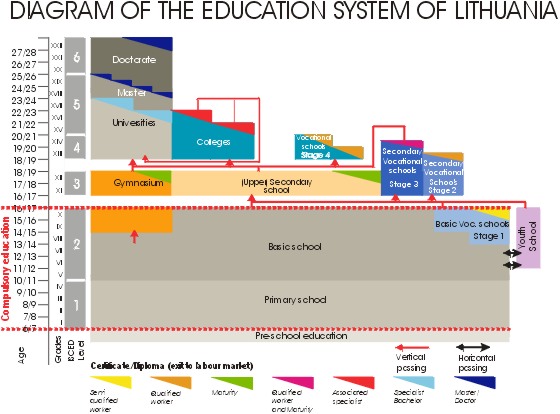
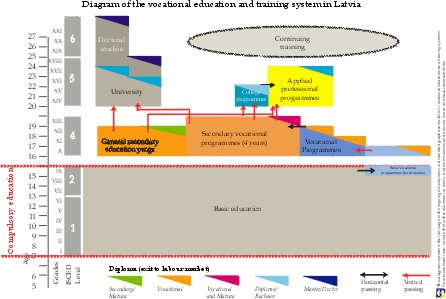
Diagrams of education systems are given in Annexes 1, 2 and 3 for Estonia, Latvia and Lithuania correspondingly. To compare the education systems in more details the following sectors of education and training are introduced:
- general education;
- basic vocational education;
- secondary vocational education;
- post-secondary vocational education;
- higher education;
- continuing education and training.
All sectors are compared and a short description of this comparison is given below.
1.1. General education
Schematic comparison of systems of general education is shown below. Solid lines fix years of schooling when graduates are awarded certificates of primary, basic and upper secondary (maturity) education. Dotted lines mark schooling years when a specific concentre is finished.
Grade
| 12 | Upper secondary | Upper secondary | Upper secondary |
| 11 | school | School | School |
| 10 | |||
| 9 | |||
| 8 | Basic school | Basic school | Basic school |
| 7 | |||
| 6 | |||
| 5 | |||
| 4 | Primary | Primary | |
| 3 | school | School | Primary |
| 2 | School | ||
| 1 | |||
| Estonia | Latvia | Lithuania |
Conclusions:
- Age of enrolment is in Estonia 7 years, in Latvia 7 years and in Lithuania 6/7 years.
- Compulsory age of schooling is in Estonia 16 years, in Latvia 18 years and in Lithuania 16 years.
- Basic (compulsory) education lasts in Estonia and Latvia 9 years, when in Lithuania starting from the academic year 1998/99 it lasts for 10 years.
- Duration of upper secondary education in Estonia and Latvia lasts 3 years, while in Lithuania starting from the academic year 1998/99 it lasts 2 years.
- To be awarded a certificate of maturity in all Baltic Countries it is necessary to spend 12 years in general education school.
- To complete the upper secondary school:
- in Estonia students have to pass five school-leaving examinations. Three of them have to be external national examinations. One, the mother tongue, is compulsory. Two others are to be chosen by students from a list of subjects. Two optional exams can be internal.
- in Latvia to be awarded a certificate of general secondary education (atestāts par vispārējo vidējo izglītību) one has to complete the courses prescribed by the chosen programme, and to pass five final examinations, including two examinations in compulsory subjects (Latvian language and literature and another examination which is set nationally each year) and three examinations to be chosen by the student. One of these five examinations must be chosen at the advanced level of the respective subject. Knowledge of the seven non-examination subjects is assessed at the end of 12th grade prior to the session of final examinations. Since recent years, centralised uniform State examinations are being introduced in order to ensure a uniform assessment throughout the country. Holders of general secondary education certificates, whose marks in at least twelve subjects are not lower than 4, have access to higher education.
- In Lithuania a system of assessment is under the reform. In a year 2000 students will have to take 5 examinations. State language (Lithuanian) is compulsory. Two exams a student is to choose from a list, and other 2 exams he/she can choose from the rest of subjects taught at school. A special value for the enrolment into higher education institutions shall have marks of the centrally controlled national examinations. In 2000, such exams will be organized in mathematics, physics, chemistry, biology and history.
1.2. Basic vocational education (ISCED97 Level 2)
In Latvia and Lithuania there are programmes for drop-outs from basic general education school. Duration of the studies in Latvia is 1-2 years (1 level of professional qualification), and in Lithuania is 2-3 years (2 level of professional qualification).
In Estonia programmes of this type do not exist.
Minimum age of enrolment in that type of programmes, in Latvia is 15 years and in Lithuania is 14 years.
1.3. Secondary vocational education (ISCED97 Level 3)
Entrance requirement is completed basic education. Minimum age of enrolment in Estonia is 15/16 years, in Latvia is 15 years and in Lithuania is 14 years.
In Estonia according to the Law on Vocational Education Institutions (1998) there is only one type of such programmes:
- Secondary vocational education programmes. At least 3 years vocational upper secondary education in a single cycle. Admission is based on successful completion of ® Põhikool. At the end of the curriculum, students have to pass school-leaving examinations including national vocational examinations. Successful students receive the secondary vocational education certificate lõputunnistus põhihariduse baasil kutsekeskhariduse omandamise kohta, which gives access to the labour market and vocational higher education (kutsekõrgharidus). Students can also pass national general examinations and receive riigieksamitunnistus certificate, which gives access to higher education.
In Latvia to this category can be attached 3 types of programmes:
- Vocational programmes. They ensure the acquisition of the 2 level of professional qualification. Duration of studies is 2-3 years.
- Professional secondary programmes (1st type). They ensure the acquisition of the 3 level of professional qualification and guarantee the access to higher education. Duration of studies is 3-4 years.
- Professional secondary programmes (2nd type). Access to those programmes is successful completion of corresponding vocational programme. Programmes ensure the acquisition of the 3 level of professional qualification and maturity certificate.
In Lithuania there are 2 types of such programmes:
- Stage II programmes. Professional qualification of the level 3 is granted. Duration of studies starting from the academic year 2000/01 will be 2 years.
- Stage III programmes. Professional qualification of the level 3 and maturity certificate are granted. Duration of programmes starting from the academic year 2000/01 will be 3 years.
1.4. Post secondary vocational education
Estonia has (by the new law The Law on Vocational Education Institutions (Kutseõppeasutuse seadus) of June 1998) one type of programmes of this type:
- For students aged 19 to 20/21 it offers 1 to 2 years vocational post-secondary education in a single cycle. Admission is based on successful completion of ® Gümnaasium (upper secondary general education.At the end of the curriculum, pupils have to pass school-leaving examinations including national vocational examinations. Successful pupils receive the post-secondary vocational education certificate lõputunnistus keskhariduse baasil kutsekeskhariduse omandamise kohta, which gives access to the labour market and vocational higher education (kutsekõrgharidus).
In Latvia there are such programmes :
- Post-secondary vocational programmes. Professional qualification of the 3 level is granted. Duration of studies is 1-2 years.
In Lithuania there are two types of such programmes:
- Stage 4 vocational programmes. Professional qualification of the 3 level is granted. Duration of studies is 1-2 years.
- College level programmes. They grant professional qualification of the 4 level and education intermediate between secondary and higher education. Duration of studies is 2-4 years.
1.5. Higher education
In Estonia and Latvia there are two types of higher education establishments: those offering university level academic and professional programmes (universities and other university-level institutions) and those offering non-university professional (applied) programmes.
The Law on professional education (1999) in Latvia provides higher professional programmes of two levels: college programmes leading to Level IV professional qualifications and professional higher education programmes leading to Level V professional qualifications. In a number of professional fields it is possible to establish college programmes as the first cycle of professional higher education.
In Lithuania is recognized only university level higher education. A Law on Higher Education is drafted and now is discussed in the Seimas which should legitimate non-university higher education. It is planned to start the fist non-university higher education programmes in the academic year 2000/01.
1.6. Continuing vocational training
The adult education system is difficult to structure, since it represents a mixture of different training levels, forms and types. Furthermore, in adult education the informal training, which relates to the need to constantly upgrade the professional qualification, is as much important as the formal training. The adult education shall be divided in three groups:
- Formal general education, when a person strives to acquire basic or secondary general education by obtaining a relevant certificate.
- Formal vocational education, when a person strives to acquire a state recognised profession.
- Non-formal adult education and training.
In Estonia Adult education and continuing training is provided by the following:
- firms themselves;
- public universities;
- state-owned and municipal education institutions (adult gymnasiums and vocational education institutions where training takes the form of evening or extramural classes, or correspondence courses);
- private and voluntary organisations such as trade unions;
- private universities, training companies and VET institutions;
- adult education institutions (mostly working as day folk high schools).
In spite of difficulties, most public universities and institutions for applied higher and vocational education provide work-related adult education. Training is conducted in the form of evening or open university/correspondence-type courses. In the case of correspondence courses, adult students enrol for a full Diploma, Bachelor’s, Master’s or Doctor’s course and receive the corresponding certification on graduation. In the Open University, they can take full courses or a part of any subject that interests them. Within a certain period – usually longer than in the case of full-time students – they may be awarded a diploma or degree, provided they have met all the normal graduation requirements. Short-term professional training courses are also offered.
Different sources indicate that there are currently over 900 private and voluntary associations in the adult education sector (excluding in-service training facilities within firms or state institutions).
In Latvia the CVT services generally are decentralised, therefore the information regarding CVT providers can be somewhat fragmented and incomplete. The main organisers/providers of CVT in Latvia are:
- Line ministries and organisations subordinated to or co-operating with those,
- Employers and employers’ organisations
- Trade unions,
- Continuing education departments and distance education centres of the universities,
- State Administration School,
- Municipal training centres,
- Chamber of craft,
- Continuing training centres,
- Education institutions, organisations, associations,
- State Employment Service.
In Lithuania adult education is carried out both at the youth education institutions listed above, through organising evening, part-time studies or relevant courses, and there are also institutions established especially for adult education and training. The later institutions may be grouped as follows:
- Adult general education schools. There are 22 schools of this type.
- Labour market training centres established in 1992 for vocational training of the unemployed (13 centres in total).
- Training centres established by the state authorities (ministries, departments, etc.) for qualification upgrading of specialists of a relevant area (such as teachers, health care providers, customs officers, etc.).
- Non-governmental institutions established at the initiative of private persons or legal persons of the private sector.
According to official statistics there were 487 institutions of the 3rd and 4th types in 1999.
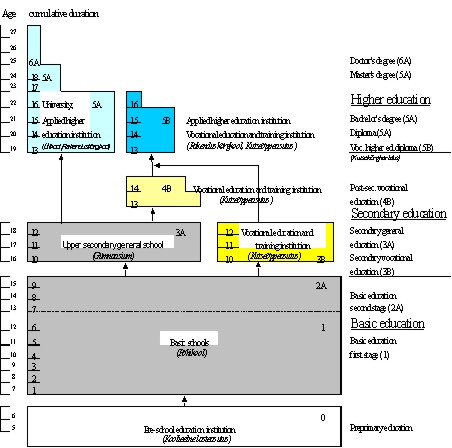
The Education System in Estonia and the ISCED 97 levels.
The choice for students is starting after basic school when there is a possibility to choose between general education and vocational education and training. A much bigger variety of possibilities is observed for students in post-secondary education. Transition of students from one type of school to the other one for all three Baltic Countries is shown in figures given below.
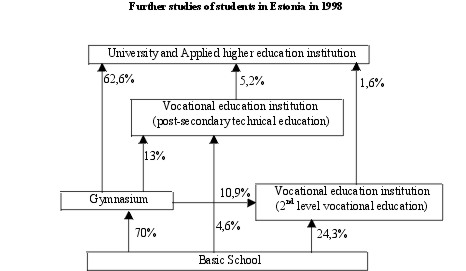
Further studies of students in Latvia in 1998
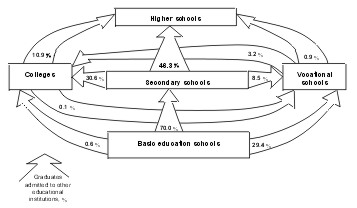
Further studies of students in Lithuania in 1998
Comparison of all three diagrams is leading to the following conclusions:
- In all Baltic countries a priority is given to academic learning: after basic school majority of students are choosing general education stream and only approximately one third are entering vocational schools.
- After graduation of upper secondary general education school majority of students are entering higher schools, colleges or post secondary VET schools.
- After graduation from vocation school absolute majority of students are entering labour market and only a small part is entering post-secondary institutions.
3. LEGISLATION
| Estonia | Latvia | Lithuania |
| Law on education (1992) is a framework law, the main aim of which is to lay down the general principles of the Estonian education system.
Law on Basic and Upper Secondary Schools (1993) sets out the conditions for establishing, running and closing state and municipal primary schools, basic schools and gymnasiums, as well as the principles governing basic and secondary general education schools.
Law on Adult Education (1993) lays down the legal conditions for education and training adults, along with legal guarantees for life-long learning in accordance with the wishes of persons concerned.
Law on Universities (1995) sets out the conditions for establishing, running and closing public universities, along with the principles governing higher education in accordance with the curricula of diploma and bachelor studies, and master and doctoral studies.
Law on Private Schools (1998) sets out the conditions for establishing such schools as the property of private individuals or legal entities, together with the principles for running these institutions, and the requirements of education given in them.
Law on Vocational Education Institutions (1998) lays down the conditions for establishing, running and closing state and municipal vocational education institutions, along with the principles governing vocational secondary and higher education, in accordance with vocational higher education curricula. This Law is applicable to the private vocational institutions as far as the Law on Private Schools does not stipulate otherwise.
Law on Applied Higher Education Institutions (1998) lays down the conditions on establishing, running and closing state applied higher education institutions, as well as the principles governing higher education in accordance with the curricula of vocational higher education and diploma studies.
Law on Pre-School Childcare Institutions (1999) sets out the conditions for establishing, running and closing pre-school institutions in municipalities, as well as principles governing the pre-school education system. |
Law on Craftsmanship (1993) determines the ways and means of craftsman’s education.
Law on Higher Education Establishments (1995) determines the main principles of autonomy and organization structure of higher education establishments (universities).
Law on Education (1998) regulates the education system as a whole, determines rights and duties of the state, municipal governments, public organizations, professional corporations, private persons, educational institutions, parents, pupils, students as well as determines the types and levels of education and educational institutions.
Law on General Education (1999) determines tasks, responsibilities and relations between the state, local government, teachers, students and parents as well as the organization of the content of general education.
Law on Vocational Education and Training (1999) determines: (1) principles of VET organization, provision and qualification awards; (2) tasks, responsibilities and relations between the state, employers, employees, teachers and students; (3) ways and means of acquiring vocational education; (4) organization of the content of vocational education; (5) principles of VET financing.
|
Law on Support of Unemployed (1990) regulates vocational training of the dismissed or notified of dismissal employees and sets forth the structure and functions of the Labour Exchange.
Law on Science and Studies (1991) defines autonomy of higher schools (universities), the general principles for organization of studies at higher schools.
Law on Education (1991) regulates education as a priority development area supported by the state, sets forth the fundamentals for structure of education system, activity and management of the educational institutions (except higher schools), regulates the compulsory and secondary general education acquired at the vocational education and training institutions. This law also defines the key regulations of the education reform.
Law on Vocational Education and Training (1997) sets forth the structure and management of the VET system in Lithuania, which is based on co-operation between state authorities and social partners. The law also regulates organization of VET and controls the formal VET. This law regulates both initial VET and labour market training.
Law on Non-Formal Adult Education (1998) regulates the system of non-formal adult education, defines the fundamentals of its structure, activity and management. The purpose of the law is to confer social guarantees to the participants and providers of non-formal adult education, as well as social partners thereof, and to assist in the implementation of the natural human right for life-long development of the personality.
Law on Higher Education (draft) defines the structure of higher education, fundamentals for organization of studies, state regulation and accountability, as well as the principles of the state funding. The draft law provides for legitimization of the binary higher education system, which enables existing of non-university higher schools alongside with the higher schools offering university level education. |
Preliminary analysis of the legal systems of Estonia, Latvia and Lithuania allows to formulate the following conclusions:
- All three Baltic Countries have already created fundamental legal documents for regulation of education and training systems.
- Legal systems of different countries are developed using different approaches:
- Estonia is concentrating on different types of institutions;
- Lithuania is regulating different sectors of education and training system;
- both are present in the case of Latvia.
4. LICENSING OF VOCATIONAL EDUCATION AND TRAINING
| Estonia | Latvia | Lithuania |
| An education license is a public document that gives a municipal school the right to perform teaching according to the vocational curriculum as indicated on the said license. The order of issuing and cancellation of education licenses, as well as the form of education license is established by the Minister of Education by a decree.
An education license shall be issued for the specified term. The license shall be issued for the term of the nominal teaching period determined by the curriculum. |
1. Education institution shall have the right to enroll students only after receiving of a license for implementation of an education program. Licensing of education program is granting a right to an educational institution to implement an appropriate education program.
2. Each education program shall be accredited within two years from a date of starting of its implementation and no less than once in 6 years in accordance with a procedure set by the Cabinet of Ministers. Accreditation of education program is providing an educational institution with a right to issue a certificate of education recognized by the state. During accreditation evaluation of implementation quality of the particular education program takes place. 3. Education institutions, except for those which implement programs of interest education and education for adults, are accredited according to a procedure set by the Cabinet of Ministers. Accreditation shall be carried out within 5 years from the day of starting of operation of an education institution. Accreditation is granting to the educational institution to lay claim to organize centralized qualification examinations and to implement further professional education programs financed by the state budget. |
1. VET institutions and enterprises, and also other educational institutions and enterprises, implementing initial VET or labour market training must have a vocational training license issued by the Ministry of Education and Science.
2. The procedure of issuance of licenses shall be established by the Government upon the recommendation of the Ministry of Education and Science. 3. The Ministry of Education and Science shall register VET licenses. 4. Enterprises engaged solely in practical training of students of VET institutions, must have a license for vocational training, issued by the Chambers or another competent institution. 5. The initial VET and labour market training recognized by the state, will be undertaken on the basis of the Register of Studies and Training Programmes. This Register is planned and managed according to the procedure established by the Government. 6. The Register shall be kept at the Ministry of Education and Science. 7. The Ministry of Social Security and Labour shall perform expert examination and submit conclusions to the Ministry of Education and Science concerning the inclusion of labour market vocational training programmes into the Register. (Excerpts from The Law on VET) |
5. REGULATION OF CURRICULUM BY THE STATE
ESTONIA
It is intended that school programmes in upper-secondary education (both its general and VET branches) should be based on the national programme. While the curriculum for general education has been completed, the one for VET is still in hand. The school programmes, which are designed to conform to the national ones, set out the specifics in greater detail.
State/national curricula of vocational education
The state curricula of vocational education establish the tasks of the vocational education, general requirements and requirements regarding the level, commencement of education and graduation, the list of mandatory courses and the total extent of education.
The general rules for VET programme stipulate (The Decree of the Government): the training objectives of vocations, specialities and occupations, the general and level requirements for starting the studies, the list of compulsory subjects, the total volume of training, the list and volume in study weeks of the general education subjects of the vocational secondary education on the basis of the basic education and the rules for graduating from the vocational education institution. Taking into account the general rules, the Ministry of Education in co-operation with the vocational councils develops the national programmes for vocations, specialities and occupations – VET programmes, on the basis of which the vocational education institutions develop their own programmes.
The general rules for the national VET programme state that there are several such programmes. Each must ensure that, in the course of learning, students develop initiative and responsibility, as well as general skills like teamwork, problem-solving, decision-making, critical thinking and communication. Where general subjects are studied, they must be those that best complement and offer appropriate support to vocational training in the area selected by the trainee.
Thus the national VET programme for young people who have completed basic school aims to encourage development of the knowledge, skills, experience and attitudes required to perform independent skilled work, on the assumption that trainees have enough general education and ability to apply this know-how in both large and small firms after they have qualified. The minimum period of study entailed is 120 weeks, during which the vocational or occupation-related dimension must account for at least 50%. 50 weeks have to be for general subjects, of which 32 weeks are compulsory and common to all pupils.
Compulsory general subjects in upper secondary education:
|
Subject group |
Subject |
Common compulsory study weeks in secondary vocational education |
Common compulsory weeks in secondary general education |
|
I |
Mother tongue |
5 |
12 |
|
|
Foreign language |
6 |
6+6 |
|
|
Mathematics |
4 |
9 |
|
II |
Physics |
3 |
6 |
|
|
Chemistry |
2 |
4 |
|
III |
Biology |
2 |
4 |
|
|
Geography |
1 |
2 |
|
|
History |
3 |
8 |
|
IV |
Civic |
2 |
4 |
|
|
Philosophy |
|
1 |
|
|
Arts |
1 |
3 |
|
V |
Music |
1 |
3 |
| Physical education |
2 |
6 |
|
|
Total common compulsory |
32 |
74 |
|
| Elective compulsory subjects |
18 (from compulsory general subjects) |
31 |
|
| TOTAL |
50 |
105 |
Curriculum of the school
The curriculum of the school is the basic document of the studies related to the appropriate vocation, speciality and occupation, that specifies the list of courses indicating the general nature of their volume and content, the possibilities of and conditions for selection of courses, as well as requirements set to commencement of studies, and graduation from the school, including graduation work.
The school shall draw a curriculum for every vocation, speciality and occupation that a student can obtain in the said school.
The curriculum of the school and any amendment there shall be approved by the school director.
The curriculum of the school as well as any amendment and addendum thereto shall be registered with the Ministry of Education according to the procedure stipulated by the decree of the Minister of Education.
LATVIA
The basic documents specifying the contents of vocational education shall be:
1) national vocational education standards;
2) occupational standards;
3) vocational education curriculum.
Levels of professional qualifications
National classification of professions is elaborated on the basis of ISCO 1988.
In accordance with the structure of levels of professional qualifications established in EU system for the evaluation of professional qualification, five levels of professional qualification have been determined in the Latvian educational system:
1) 1.level of qualification – theoretical and practical training which enables to perform simple tasks in a definite sphere of practical activity;
2) 2.level of qualification – theoretical and practical training which enables to perform independently a qualified work of a trade specialist – performer;
3) 3.level of qualification – an increased theoretical training that enables to fulfil the duties of a definite trade specialist – performer – which include also the planing and organisation of the performing of work;
4) 4.level of qualification – theoretical and practical training which enables to perform the complicated work of a trade specialist – performer – as well as organise and manage the work of other specialists;
5) 5.level of qualification – the highest qualification of a specialist in a particular industry that enables to undertake also scientific work.
National vocational education standards
Pursuant to the law the national vocational education standards, namely, national vocational education standard, national vocational secondary education standard and the national first level professional higher education standard in accordance with the level of education shall specify:
1) the strategic objectives of the educational programmes;
2) the mandatory contents of education;
3) the basic principles and the procedure of assessing the education completed.
The national vocational education standards shall be developed by the Ministry of Education and Science and shall be approved by the Cabinet of Ministers.
Occupational standard
Occupational standard shall specify the basic requirements for vocational qualification, as well as specific requirements needed for performing the main operations in the profession concerned.
Occupational standards shall be established by special laws or regulations of the cabinet of ministers. Occupational standards may also be established by authorised institutions, if so stipulated by the law or regulations of the cabinet of ministers.
Vocational education programmes
Vocational education programme shall be a document of vocational education that pursuant to the national standards of vocational education of the appropriate level of education shall specify:
1) objectives of the vocational education programme;
2) contents of the vocational education programme;
3) plan of implementation of the vocational education programme;
4) requirements with regard to previous education;
5) personnel, finance, and material resources required for the implementation of the programme.
Vocational education programme shall be developed by the relevant school and shall be co-ordinated with the founder of the school.
Structure of programmes
Ratio of theory and practice
| Level of qualification | Theory | Practice |
| 4 | 70 % | 30 % |
| 3 | 50 % | 50 % |
| 2 | 35 % | 65 % |
Compulsory subjects (secondary education)
| Communication sciences | Mathematics and natural sciences | Economics and social sciences |
| Latvian language
Foreign language Communication |
Mathematics
Informatics
|
Business
Environment education |
LITHUANIA
Classification of Occupations was approved in summer 1999, it is elaborated on the basis of ISCO-88. A structure of occupational standard has not been legitimised yet; no one occupational standard has been created.
By the order of the Minister of Education 5 vocational education levels are introduced in Lithuania.
Levels of vocational education in Lithuania
| Level of vocational education | Description of the level of vocational education | Level of general education | Duration of programme |
| Level 1 | Ability to carry out simple, routine work operations not requiring autonomous decisions | No special requirements | Up to 1 year |
| Level 2 | Ability to perform specialized work not requiring important autonomous decisions | Primary/ basic | 1 to 2 years |
| Level 3 | Ability to perform fairly complicated work in areas requiring responsible and independent decisions | Basic/secondary | 2 to 4 years |
| Level 4 | Ability to perform complicated work requiring personal responsibility in specific areas of activity. Leads to ability to carry out planning, organizational, administrative, and control functions independently | Advanced VET school | 3 years |
| Level 5 | Ability to perform complicated creative work in broad, new areas of activity; ability to engage in autonomous vocational activity based on thorough knowledge. Leads to ability to plan and assess the work of others and to assume managerial functions | Non-university higher | 4 to 5 years |
The structure of the VET standard is as follows: the title page, the general description, professional qualifications, objectives of teaching, final assessment. The achievements in the development of VET standards :
§ 8 standards are approved;
§ 4 standards are undergoing a process of approval;
The contents of the initial VET includes general education, general culture and vocational subjects, which are further divided into theoretical and practical training. The Table provides information on the shares of subjects taught in the curriculum:
Ratio of Subjects Taught at Vocational Schools (%)
| Duration of training | VET subjects
(%) |
General education subjects (%) | General culture subjects (%) | Auxiliary education (%) |
| Stage I: 2 years | 80.4 | 15 | 5 | |
| Stage I: 3 years | 62 | 18.4 | 15 | 5 |
| Stage II: 3 years | 70.4 | 22.7 | 6.9 | |
| Stage III: 4 years | 46 | 36.6 | 8.1 | 9.3 |
| Stage IV: 1 year | 80.7 | 15 | 4.2 | |
| Stage IV:1,5 years | 84.2 | 11.6 | 4.2 | |
| Stage IV: 2 years | 85.4 | 10.4 | 4.2 |
The General Requirements of the initial VET specify, that practical training at vocational schools must make 70% of all time allocated to vocational subjects.
The State Register of Initial VET Programmes has been established and approved by the Order of the Minister of Education and Science in July 1996. The Register lists the programmes by fields of activity; every programme has its state code, as well as specified minimal education (qualification), length of education, and professional qualification conferred. Moreover, qualification definitions of the programmes briefly describe the skills and knowledge to be acquired by a person after completing a particular programme.
In November 1996 the General Requirements for Programmes for Initial Vocational Training have been approved by the Order of the Minister of Education and Science. The said document ensures transparency and equivalency of qualifications. The design of training programme is the responsibility of each school. The training programmes are assessed by VET Central Expert Commission of the Ministry of Education and Science, and by external experts. Activity of the Expert Commission is organised by the MES Division of vocational schools. The proposed training programmes are approved by the Director of the Specialist Training Department of MES on the basis of the expert conclusions.
The college type study programmes consist of the following groups of subjects:
§ General subjects (philosophy, foreign languages, etc.);
§ Special subjects, further divided into
– general studies,
– speciality,
– specialisation.
§ Auxiliary education.
The emphasis is laid on practical and applicable nature of the knowledge conferred. At least 30 % of the total study time is allocated for practical training of students.
Transparency and equivalency of programmes are guaranteed by the State Register of college type study programmes approved by the Order of the Minister of Education and Science in June 1996, as well as by the Requirements for College Type Study Programmes, approved in November 1996.
The list of general subjects and the scope thereof at college type schools is determined by the MES. The subjects below are compulsory (minimum number of academic hours is indicated on the right side):
| Subject | Minimum number of contact hours |
| Philosophy or sociology | 60 |
| Foreign languages | 180 |
| Culture of state language and terminology | 60 |
| Mathematics (for arts and music programmes is not compulsory) | 100 |
| Physics, chemistry (in technical and technology programmes) | 70 |
| Information teechnology | 60 |
| Business economy | 80 |
| Law | 60 |
| Labour safety and civil security | 30 |
The list of compulsory special subjects and minimum scope thereof is defined by the General Requirements of different study fields, or, if the Requirements are not available, by the school according to the ministerial regulatory legislation and through co-ordination with organisations representing the employers.
Specialisation subjects are selected by an individual school, which does so considering its possibilities and the needs of the local labour market at a particular point of time.
The schools themselves design training programmes, and they also have much freedom in developing the contents of teaching. Thus, the study programmes designed for the same purpose by two different schools are rather different, too. When developing the plan of studies, a school defines the specific composition of general subjects and actual number of academic hours, the list and number of hours to be allocated to special subjects, and has 10-15% of the programme time which it can use for free selection of specialisation’s. Moreover, the schools demonstrate their innovation when selecting the teaching methods.
College type schools or founders thereof, including private schools, propose the programmes to MES, where they are assessed by the Central Expert Commission and invited experts. Activity of the Expert Commission is organised by the Department of College Type Studies of MES. The programmes prepared by the schools run by MES are approved by the Director of the Specialists Training Department based on conclusions of the Central Expert Commission. The study programmes of schools run by other bodies (not MES) are approved by the founder of the school upon co-ordination thereof with the Director of the Specialist Training Department.
Concluding remarks:
1. In all three countries there is a tendency to simultaneously provide both general education and vocational training.
2. In all three countries state is regulating objectives of training, and schools have a considerable freedom when developing curriculum. Therefore a teaching plan can differ from school to school.
3. Types of programmes differ considerably from country to country.
ESTONIA
The Decree of the Minister of Education “On approval of the procedures for student enrolment” – the enrolment of the students to the vocational education institutions are ratified in the law on the Vocational Education Institutions, the procedures include the list of the documents, which must be presented to the enrolment committee and the time when the student is informed of enrolment.
Admission to upper secondary general or vocational schools is based on the compulsory education certificate. Pupils can apply for admission to the kind of school they prefer. In some sectors, satisfactory completion of general upper secondary education is the prerequisite for entry to vocational education. Admission to these post‑secondary vocational schools is based on the upper secondary school leaving certificate.
LATVIA
Every Latvian citizen and a person who is entitled to the alien’s passport issued by the Republic of Latvia, a person who has received a permanent residence permit, as well as citizens of European Union countries who have received temporary residence permits as well as their children shall be equally entitled to acquire education irrespective of his/her social or financial status, race, nationality, sex, membership in religious and political organizations, status of health, occupation and the place of residence.
Enrolment of students in vocational education programmes regulated by the law on vet
1) A person shall be enrolled in a vocational basic education and vocational (industrial) education programme without any limitations with regard to previous education not earlier than in the calendar year, when the said person reaches the age of 15.
2) A person shall be enrolled in vocational secondary education programmes after having completed general basic education or vocational basic education.
3) A person shall be enrolled in the first level professional higher education programmes after having completed general secondary education or vocational secondary education.
4) Enrolment in vocational further education programmes shall not be specified.
5) The ways how the staff (practitioners) acquire the vocational education programmes shall be specified by this law, the law “On craftsmanship” and other normative acts.
LITHUANIA
Access to vocational schools and to labour market vocational training is regulated by the Law on VET:
Article 25. Admittance to Initial VET Institutions
1. Persons no younger than 14 years of age shall be admitted to initial VET institutions who:
1) have no vocation;
2) desire to acquire another vocation as a qualified worker.
2. The founder shall establish the conditions and procedure of student admission.
Article 28. The Stages of Initial VET
1. The VET system (description of sages is given in the section “Comparison of systems of education) shall include the following sages:
1) stage I … Only persons not having a basic education shall be admitted;
2) stage II … Persons having basic education shall be admitted;
3) stage III … Persons having basic education shall be admitted;
4) stage IV … Persons having a general secondary education shall be admitted.
Article 34. Admittance at Labour Market Vocational Training Institutions
1. Labour market training institutions shall admit persons:
1) who are employed at enterprises, who in the face of unemployment:
a) must enhance their qualification;
b) must change or acquire a new vocation;
2) the unemployed or persons in search for employment, who:
a) must enhance their qualification;
b) must change or acquire a new vocation;
3) who are starting their own business.
2. Persons over 18 years of age shall study at labour market training institutions, while those younger shall be included only if they have already acquired initial vocational education. Exceptions shall be granted according to the procedure established by the Ministries of Education and Science and Social Security and Labour.
More detailed regulation of the conditions of admittance is specified in the corresponding decree of the Minister of Education and Science for the initial VET and in the decree of the Minister of Social security and Labour for the continuing training.
7. ASSESSMENT OF STUDENTS ACHIEVEMENTS
ESTONIA
Assessment of students at VET institutions is on a five-point scale, where 5 is “very good”, 4, “good”, 3, “satisfactory”, 2, “unsatisfactory” and 1, “poor”.
Students who complete courses at VET institutions receive a certificate. At present, however, these certificates do not represent a formal qualification as such. By the Law a student shall be deemed graduated from the school after completion of the applicable curriculum, including passing of the vocational state final examinations and school examinations, as well as the graduation work according to the stipulations set by the decree of the Minister of Education. The number and field of examinations is determined by the school curriculum.
This may change in the future, with implementation of an employee qualification system and more thorough assessment of qualifications.
The graduation certificate issued by the school shall serve as the evidence of graduation, the form and procedure of issuing of the said certificate is established by the Government of the Republic. The graduation certificates shall be filed with the register of graduation documents as stipulated by the decree of the Minister of Education.
LATVIA
Final examinations of the vocational education programmes
1) Qualification examinations and other final examinations specified by the national vocational education standards shall be held upon completion of vocational education programmes. The Minister of Education and Science shall se the procedure of holding national exams
2) A student enrolling in a vocational education programme without having completed the basic education shall be ensured the necessary adjustment and upon passing the final examinations the student additionally shall be issued a document certifying the completion of general basic education.
3) The Cabinet of Ministers shall confirm the list of vocational qualifications requiring to pass the final examinations.
4) The accredited vocational schools, where the final examinations are held, shall be specified by the Minister of Education and Science, co-ordinating it with the founder of the school and the Co-operation Board. Structural units – study and examination centres shall be established in the said schools, which in co-operation with the vocational education support organisations, the branch ministries and professional organisations and schools in accordance with the requirements of the vocational education standards, shall organise the state administered vocational qualification examinations.
LITHUANIA
General regulations of assessment of qualifications acquired in initial VET and labour market training courses are defined in the Law on VET:
Article 21. General Provisions of Qualification Examinations
1. Upon the coordination with the Council (Council is a tripartite national body), a competent institution shall establish the organizing procedure and supervision of qualification examinations.
2. The following types of examinations shall be offered for qualifications recognized by the State:
1) qualification examinations;
2) qualified worker’s examination.
3. An examination shall be comprised of theoretical and practical examinations.
4. Examinations shall be organized by examining commissions that have been formed according to established procedure.
Article 22. Examining commissions
1. One commission for qualification examination shall be formed for the theoretical and practical examination. This commission shall assign problems for those beeing examined and shall assess their performance.
2. The commission shall equally represent employers, trade unions and vocational teachers.
Article 23. Certificates
1. State recognized qualification certificates include: a certificate of qualification and a diploma of qualified worker.
2. The content, form and procedure of issuance of certificates shall be established by the following, taking into consideration the proposals of the Council:
1) for initial VET, by the Ministry of Education and Science;
2) for labour market vocational training, by the Ministry of social security and Labour.
3. Certificates shall be registered at the Ministry of Education and Science.
For initial VET additional regulations are as follows:
Article 31. Qualification Examinations in Initial VET
Within the vocational training system shall be given the following:
1) qualification examinations;
2) qualified worker examinations.
Article 32. Certificates of Initial VET Qualification and the Diploma of Qualified Worker
1. A certificate of qualification shall be issued to students upon completion of the VET programme of Stage I.
2. A qualified worker diploma shall be issued to students upon completion of the VET programmes of Stages II, III and IV.
Not all regulations of the Law for initial VET are met in practice. First, though there is an intention to delegate the responsibility for organization of final examinations to Chambers of Commerce, Industry and Crafts and the experiment is started, it covers only two counties of Lithuania until now. Second, commissions are composed of the representatives of employers and teachers, trade unions being not ready to participate.
For the labour market vocational training the Law defines:
Article 38. Qualification Examinations in Labour Market Vocational Training
Qualification examinations will be taken following the conclusion of training accordind to the programme which is included in the Register of Studies and Training Programmes.
Article 39. Certificate to Perform Certain Work or Certain Function and the Certificate
of Qualification
The completion of study according to the programme included in the labour market vocational training Register of Studies and Training Programmes, shall result in the issuance of:
1) a certificate attesting to the preparedness to perform a job or duties in keeping with the acquired vocational education;
2) certificate of qualification.
ESTONIA
The social partners (the representatives of employers, the employees’ associations and the representatives of the Government of the Republic) in vocational education and training are involved in education via the Vocational Councils, – at the Estonian Chamber of Commerce and Industry. The vocational councils have been established according to the Law on Vocational Education Institutions and in the frames of the creation of the National Employee Qualification System. They develop qualification requirements and vocational standards, and through that are involved in the preparatory stage of programme development for the courses at the educational institutions.
According to the law, vocational education institutions have to have a school council. It consists of the: representatives of founders of the vocational education institution (administrating ministry), professional/vocational and occupational experts on the fields taught in the school, employers connected to the educational fields, local municipalities, public and cultural people in the region where the school is located and the student body. The council approves the school development plans; confirms the report about following the budget; confirms enterprises for practical experience.
LATVIA
Consultative representation of the social partners is at 5 levels:
§ legislative power (the Saeima);
§ executive power (the Cabinet of Ministers);
§ related issues (labour safety, social security, professional training);
§ professional and sectoral level;
§ company level.
The Tripartite Council of Professional education (establish in 1999) is an advisory council which develops suggestions for state policy and strategy in the area of professional education. The involvement of employers in VET was not legally regulated and it was mainly carried out through personal contacts. The new Professional Education Law envisages competencies of employers in VET as well as their involvement in the Tripartite Vocational Education Council.
LITHUANIA
Interaction between the VET system and the production sector is manifested on four levels:
§ national level;
§ industrial branch (e.g. agriculture, construction, transport) level;
§ regional level;
§ institutional level.
On the national level, the VET Council was established in 1998 according to the rules defined in the Law on VET:
Article 7. The Vocational Education and Training Council of Lithuania
1. The Vocational Education and Training Council of Lithuania is the consultative body in deciding strategic questions in VET.
2. The council shall be comprised equally, of members of state administrative institutions, and of organisations representing the interests of employers and employees.
3. The Government shall approve the Statute of the Council and its structure.
To advise the Ministries of Education and Science and Social Security and Labour on the issues of VET policy development in a relevant branch of economy , 14 Industrial Lead Bodies have been established in 1999. Following the principle of the tripartite partnership, the Lead Bodies equally represent the education system, employers and trade unions. One of the most important fields of activity of Lead Bodies is the development of VET standards.
At a county level the Regional VET Councils were set up in 1998. Their duty is to support administration of counties in the development of regional VET policy.
On the institutional level, the interaction between the labour market and the VET system is realised through a direct contact of schools with enterprises; i.e., the practical training of students is conducted at specific enterprises, on one hand, and the employers participate in management of schools (through the School Council), on the other hand. The Examination Commission approved by an institution representing the employers (e.g., Chambers of Commerce, Industry and Crafts, Chamber of Agriculture, etc.) assesses the knowledge of students. A decision is made to fully delegate a function of final qualification assessment to Chambers. A corresponding experiment is already made in 2 counties.
Concluding remarks:
1. Tripartite national advisory bodies are set up in Latvia (The Tripartite Council of Professional Education) and in Lithuania (The Vocational Education and Training Council).
2. In Estonia and Lithuania the main actors in social dialog from the side of employers are the Chambers: the Chambers of Commerce and Industry in Estonia;; the Chambers of Commerce, Industry and Crafts and the Chambers of Agriculture in Lithuania. In Latvia social partnership is dominated by the Latvian Employers Confederation.
3. Estonian Chambers of Commerce and Industry are directly responsible for the issue. In Lithuania social partners are involved in VET standards development as experts, the Industrial Lead Bodies being the responsible structures.
4. At the institutional level social partners are involved into VET via practical training of students, participation in school management and in final assessment of qualification of graduates.
5. Participation of trade unions in social dialog is rather limited.
9. MANAGEMENT AND ADMINISTRATION
ESTONIA
The Role o the Government of the Republic
The Government of the Republic have the authority to :
§ adopt state education development plans and ensure their implementation;
§ determine procedures for the establishment, reorganization and closure of public educational institutions;
§ open, reorganize and close state universities and applied higher education institutions; approve the statutes of applied higher education institutions;
§ determine procedures for tuition fees and payments, and payment procedures in public educational and learning institutions and state universities;
§ determine state concessions to schoolchildren, students and educators, including credit benefits;
§ determine remuneration principles for the staff of public educational institutions and state universities.
The Ministry of Education:
The Ministry of Education shall:
1. determine procedures for state supervision of educational institutions and state educational standards; control compliance with the legislative acts concerning education and the observance of state educational standards;
2. compile and implement the state education classification standard;
3. coordinate and manage local governments and other ministries of the Republic in the organization of education; coordinate with them proposals for the establishment, reorganization and closure of public educational institutions, according to the procedures determined in legal acts;
4. establish, reorganize and close state educational institutions, except universities and applied higher education institutions;
5. direct and organize the preparation of curricula, study programs, textbooks, teaching and study aids for public educational institutions (except universities); ensure their publication, and issue recommendations for the use of educational literature;
6. guarantee a system for the service for public educational institutions and for educator methodology;
7. determine procedures, on which basis study programs shall be recognized, the requirements presented therein shall be fulfilled, and documents proving education shall be issued;
8. determine procedures for teacher certification and upgrading of professional qualifications; organize training and in-service courses for educators;
9. contribute to the implementation of state research policies and commission research on education;
10. participate in forecasting the requirement for specialists and skilled workers, as well as commission their training;
11. coordinate training of specialists and skilled workers in applied higher education institutions and in vocational schools; coordinate in-service training and retraining for specialists and skilled workers;
12. commission universities;
13. cooperate with educational and research institutions from other countries and from international organizations;
14. develop the standards for state funding of education;
15. issue and revoke education licenses (operating licenses) for private educational institutions and other legal entities involved in teaching;
16. appoint and dismiss heads of state educational institutions (except universities);
The role of the Local governments :
The local governments prepare and implement education development plans for their administrative region and organize vocational guidance and counseling of children and adolescents.
Management at school level (The Law on Vocational Education Institutions)
The director
1. The school shall be managed by the director whose responsibility is to secure efficient work of the school.
2. The director shall be, within the scope of his or her competence, responsible for statutory operation of the school, its overall state and development as well as legitimate use of the financial assets of the school.
3. The director shall be answerable to the school council as well as the body that has appointed him/her.
4. The director:
§ represents the school and acts in the name of the school, performs the tasks that are required for compliance with his/her tasks as stipulated herein;
§ presides at the council of teachers meetings of the school;
§ secures compliance with the resolution of the school council and the council of teachers of the school;
§ determines the order of substitution of the director;
§ serves as the employer of the staff members, and approves their job descriptions by his/her order;
§ approves by his/her order the domestic rules and the rules for conducting the school’s business;
§ secures drafting of the school budget, as well as budget performance;
§ secures completion and submission of reports required by the laws;
§ resolves any other issues delegated to him/her.
§ The director shall issue orders.
To fill the office of the school director an open competition is organised.
Such competition shall be carried out by the school council as stipulated by the decree of the Minister of Education.
Based on the results of the above competition the director shall be appointed to the office for the term as announced at the said competition, however the said term shall not exceed five years. The employment contract with the director of a state school shall be concluded, amended and terminated by the Minister heading the ministry under which administrative jurisdiction the state school falls, the employment contract with the director of a municipal school shall be concluded, amended and terminated by the head of the township administration or the town mayor according to the recommendation of the township or town administration.
The teachers’ board
The board includes teachers and other members of teaching staff (incl. the director of the school). The task of the teachers board is to resolve matters pertaining to educational activities of the school. The work regulations of the board is stipulated in the school statutes.
The school council
The school council is a body, comprising from five to nine members, appointed by the head of the school’s overhead institution, the purpose of which is to direct the operations of the school, as well as to resolve issues pertaining to the development of the school, its assets and budget.
The council of a state school includes the representatives of the ministry under which administrative jurisdiction the school falls, the council of a municipal school shall include the representatives of the appropriate township or town administration, experts in the field of the vocations, specialities and occupations that are taught at the school, the representatives registered associations of the employers and employees (clerical workers) as well as vocational associations and of the students organisations, and it is formed for the term of three years.
The council 1)approves the development plan of the school, 2)submits an application for budgetary financing of the school to the overhead organisation of the school, 3)approves by its resolution the report on school’s budget performance,4)considers the reports of the school director and his/her deputies, and, based on the said reports, takes appropriate resolutions, 5)approves by its resolution the public and municipal establishments, legal entities under the public and private laws, as well as sole proprietors where the practical training of the students takes place.
LATVIA
Cabinet of Ministers shall:
establish forms of graduation certificates recognized by the state and the procedure and criteria for issuing them;
1. establish the procedure for recognition of education certificates issued by a foreign country in accordance with the standards of the education certificates issued by the Republic of Latvia;
2. establish a procedure according to which the state or a municipality may finance private institutions;
3. establish the procedure of taking loans for the higher educational studies and re-paying them.
4. establish, re-organize and close state educational institutions at the proposal of the Minister of Education and Science or other Minister;
5. confirm statute of colleges;
6. establish the procedure for registering and accreditation of educational institutions;
7. establish procedure for certification of heads of secondary educational institutions founded by the state or a municipality;
8. establish regulations and procedure for accreditation of institutions of education;
9. establish procedure for licensing and accrediting of educational programs implemented by an educational institution;
10. confirm a list of pedagogical professions and positions.
11. confirm requirements for necessary education and professional qualification of teachers corresponding with pedagogical professions;
12. establish a procedure for certification of pedagogues;
13. establish a procedure according to which the state finances supply, approbation and purchase of teaching materials;
14. establish amount of salaries and the procedure of payment;
15. once in four years prepare and submit to the Saeima for approval education development program for next four years;
16. establish state standards in education;
17. establish a minimum of financing and material provision for education institution;
18. establish pedagogue’s work load.
Ministry of Education and Science shall:
1. implement the unified State policy in education and the strategy for development of education;
2. draft normative acts in education;
3. create and update registers of educational institutions and educational programs as well as the register of pedagogues;
4. carry out licensing of educational institutions;
5. carry out accreditation of education programs and higher education institutions according to procedure set by the Cabinet of Ministers;
6. organize educational and professional improvement of pedagogical work, co-ordinate research-methodological work;
7. prepare state standards of education;
8. draft proposals and submit a request for the financing of education, science, sports and the youth affairs by the state budget in accordance with the set procedure;
9. control legal utilization of finances allotted for education from the state budget in education institutions under its supervision;
10. co-operation of state education institutions in education with foreign countries and international institutions;
11. prepare samples of educational programs, subject or course programs in accordance with the requirements of the state standards of education;
12. organize the preparation of standard statutes for educational institutions, institutions of educational support;
13. organize the state order for writing and publishing of readers and teaching materials corresponding with basic educational programs;
14. establish and co-ordinate the procedure for acquiring of pedagogical education and professional improvement;
15. organise the ordinate state’s evaluation of professional qualification of teachers and directors of educational institutions;
16. establish the procedure for state examinations of the accredited educational programs;
17. organise work on the content of text books corresponding with the educational standards;
18. control the results of the study process of state financed educational institutions, prepare and implement the undertakings for improvement of the study process quality;
19. establish, maintain, and supervise state institutions of educational support;
20. confirm the samples of educational programs corresponding with the requirements of the state standards in education;
21. confirm the classification of registers of educational institutions, educational programs and the register of pedagogues;
22. submit to the Cabinet of Ministers the proposals concerning the establishment, re-organization and liquidation of education institutions and state institutions of educational support by co-ordinating it with the corresponding municipalities;
23. confirm the statutes of education institutions and institutions of education support founded by the state;
24. employ and dismiss directors of education institutions which are under supervision of the Ministry of Education and Science;
25. propose dismissal of a directors of municipal education institutions;
26. monitor the financial and economic management of the educational institutions under it supervision.
Other ministries [ministries of other branches] shall:
1. after co-ordination with the Ministry of Education and Science, submit to the Cabinet of Ministers proposals concerning the establishment, re-organization and liquidation of an educational institution;
2. set the content of specialized subjects, prepare the programs and standards of a specialized subjects or courses;
3. prepare and confirm the standard of the programs for the vocational education, and control their implementation in the educational institutions under their supervision;
4. ensure the work of the educational institutions under their supervision;
5. monitor the financial and economic management of the educational institutions under their supervision;
6. in agreement with the Ministry of Education and Science establish the procedure of state examinations for the accredited educational programs.
Municipality of a region shall:
1. in agreement with the Ministry of Education and Science establish, re-organize and close institutions of vocational education. Educational institutions founded by the regional municipality shall be under the supervision of that particular municipality.
2. employ and dismiss the heads of the educational institutions which are under its supervision, after co-ordination with the Ministry of Education and Science;
3. finance the educational institutions which are under its supervision to the extent no less than set by the Cabinet of Ministers, and supervise management of the financial resources;
4. guarantee the transferring of financial means allotted for the pedagogues’ salaries from the State budget into the accounts of the educational institutions and the institutions of educational support under its supervision;
5. provide students with prophylactic medical care, first medical aid at the educational institutions under its supervision according to the procedure and in amount set by the Cabinet of Ministers;
6. provide students with the professional guidance;
7. organize the education for adults;
8. organizationally assist the educational institutions located on its administrative territory with the provision of teaching and methodological literature, and other teaching materials;
9. organize the improvement of professional qualifications of pedagogues and co-ordinate and provide the methodological work;
10. establish and maintain the data base (information base)
11. state the number of students of higher education.
LITHUANIA
The Competence of the Ministry of Education and Science in the VET Area (Article 8, Law on VET)
The Ministry of Education and Science shall:
1. found, reorganise and liquidate VET institutions subordinate to it, according to the procedure established by the Government;
2. approve the foundation and reorganisation of non-subordinated to it state, municipal and non-state VET institutions, submit proposals to founders regarding liquidation of non-state VET institutions, when their activity proves to be contrary to laws;
3. issue licenses for VET according to the procedure established by the Government;
4. establish the extent of cultural subjects within the education and training programmes;
5. establish the general qualification requirements of vocational teachers at VET institutions and organise certification thereof;
6. organise in-service training and requalification of instructors of vocational training institutions subordinate to it;
7. establish the general requirements of the statutes of VET institutions;
8. organise preparation of national curriculum and the teaching and publication thereof;
9. administer the Register of Studies and Training Programmes;
10. ensure vocational guidance at general education and vocational schools;
11. establish together with the Ministry of Social Security and Labour, the procedure of supervision of VET institutions.
The Competence of the Ministry of Social Security and Labour in the Vocational Training Area (Article 9, Law on VET).
The Ministry of Social Security and Labour shall:
1. establish, reorganise and liquidate state vocational training institutions subordinated to it, in accordance with the procedure established by the Government;
2. co-ordinate the foundation and reorganisation of non-subordinated to it, state and non-state vocational training institutions within the area of labour market vocational training;
3. perform expert examination and submit conclusions regarding the issuance of licences for labour market vocational training;
4. supervise the activity of licensed labour market vocational training institutions;
5. establish the procedure of labour market vocational training;
6. organise extra-curricular vocational guidance of labour market and youth;
7. perform expert examination and submit conclusions to the Ministry of Education and Science concerning the inclusion of labour market vocational training programmes into the Register of Studies and Training Programmes;
8. establish additional qualification requirements for labour market vocational training teachers;
9. organise in-service training and retraining of teachers of vocational training institutions subordinate to it.
The Competence of Ministries, Departments, County Governors and Municipalities in the Vocational Training Area (Article 10, Law on VET)
1. Other ministries, departments, county governors and municipalities:
1. may found, reorganise and liquidate the institutions of VET subordinate to them, in accordance with the procedure established by the Government;
2. organise preparation of training programmes and instruction materials, as well as publication for vocational training institutions subordinate to them;
3. organise in-service training and requalification of teachers in vocational training institutions;
4. conduct an expert examination and provide conclusions concerning the issuance of licenses for vocational training in their activity spheres according to the applications of the Ministries of Education and Science or Social Security and Labour
5. submit proposals to the Education and Science and Social Security and Labour Ministries in reference to the Register of Studies and Training Programmes.
2. The county governor’s administration shall:
1. carry out state supervision of VET institutions according to the procedure established by the Ministry of Education and Science;
2. submit proposals to founders regarding the scope of enrolment at vocational training at county state institutions and enterprises.
Internal management of schools
General Regulations of the initial VET institutions (Order No 467 of the Minister of Education and Science, 20.03.1998) legitimate management and self-government of the initial VET institution.
Vocational schools are subordinate to the founders. According to the established procedure the founder appoints and dismisses a Principal who leads a vocational school. The Principal of vocational school is responsible for:
§ the institutional activity and its results; its representation;
§ the implementation of legal base;
§ financial management and funding utilization, care of material capacity, its functioning and up-grading.
§ control of the curriculum implementation, teachers’ work, encouragement staff for the improvement of the qualification;
§ staff management- appointment, dismissal, penalty, inducement;
Institutional Council is the highest competence body of the VET institutional self-governance. It represents the interests of the institution staff, students and their parents, and social partners. Delegated persons from Teachers’ and Students’ Council, and by the Parents’ general meeting make up the Institutional Council. Composition of the Institutional council is approved through the general meeting of teachers, students, their parents and representatives of social partners.
Institutional Council carries out the following functions:
§ defines strategy of the training process and trends for its improvement;
§ plans and controls funding and expenditure; allotment of non-budget co-funding; plan students scholarships and grants;
§ plans and solves problems related to the establishment of new, termination and re-organization of the institutional sub-divisions,
§ deals with the arrangements of students’ practical training in enterprises and their future employment,
§ initiates the cooperation between VET institution and social partners.
General Regulations of the College type school activity (Order No 1324 of the Minister of Education and Science, 05.12.1996)
Concluding remarks:
1. In all three countries main responsibility for initial vocational education and training at the national level is delegated to the Ministry of Education.
2. The main founders of public VET schools in Latvia and Lithuania are Ministries of Education and Agriculture. In Estonia all public VET schools are under the Ministry of Education.
3. In Estonia the Ministry of Education is responsible for the management of the continuing training system too. In Lithuania this responsibility is delegated to the Ministry of Social Security and Labour. In Latvia case the responsibility is split between several ministries.
4. Function of administration of VET school is delegated to the principal of it. The principal is appointed by the founder of the school.
5. In Estonia and Lithuania the School Council is established to direct activities of the school. In Estonia this council is appointed by the founder of the school, and in the case of public school the Ministry of Education is delegating its representative. In Lithuania the School Council is appointed by the principal of the school.
10. REQUIREMENTS FOR TEACHERS QUALIFICATION
ESTONIA
The educational requirements of the pedagogues working in the vocational education institutions (incl. the headmasters of the vocational education institutions) are stipulated by the decree of the Minister of Education “On approval of the qualification requirements for the pedagogues of the vocational education institutions”. In general, the pedagogue in a vocational education institution must have acquired higher education on the subject or speciality he or she is teaching or higher education on other field, the headmaster must have acquired higher education and at least 3-year leadership experience or must have covered or must be covering the 240-hour leadership course.
LATVIA
The right to work as a teacher in a vocational school shall be entitled to a person having an appropriate vocational education (qualification) and pedagogical education in accordance with the requirements approved by the Cabinet of Ministers. The professional qualification of a vocational school teacher shall be certified by nationally recognized documents about the relevant vocational education (qualification) and pedagogical education. (from the VET Law)
Restrictions on Working as a Pedagogue (from the Law on Education)
A person shall not be permitted to work as a pedagogue:
1) who has been convicted for an intentional crime and has not been rehabilitated;
2) whose capability to act is limited by normative acts;
3) at state or municipal educational institutions – who does not possess a certificate about the command of the state language on the highest level, except for the academic staff of higher educational institutions and citizens of other states or stateless persons who participate in implementation of education programs on grounds of an international agreement, as well as pedagogues working at an education institution or a branch founded by a foreign country,
4) who by court decree has been deprived parental rights.
Traditionally there are no programmes for initial training of VET teachers in Latvia – there are only programmes for training of general subject teachers, primary school teachers, music or arts teachers, teachers of physical education. The teaching staff of VET schools usually has received training in one of the following two ways:
- in the appropriate vocational field (higher or secondary vocational education)
- pedagogics (higher education)
LITHUANIA
According to the Law on VET the Ministry of Education and Science is defining qualification requirements for teachers of initial VET. However no specific requirements for VET teachers are issued. Most of the teachers have university level higher education and have no work experience according to the profession they are training for. Only a small part of teachers have had extensive pedagogical training, though majority of teachers have attended corresponding courses of in-service training.
A vision of qualification requirements for VET teachers is formulated in the White Paper on VET, 1998. At present work on the implementation of this vision is started.
Concluding remarks
- In all Baltic Countries VET teacher training is not considered as a priority, the main attention being paid to the training of teachers for general education schools.
- In Estonia and Lithuania most VET teachers are university graduates, while in Latvia the teaching staff of VET schools usually has received training in one of the following two ways -in the appropriate vocational field (higher or secondary vocational education) or pedagogics (higher education).
11. STUDENTS RIGHTS
ESTONIA
The student shall have the right (The Law on Vocational Education Institutions):
1) to choose a school matching his/her interests and abilities;
2) to learn about the curriculum, statutes as well as domestic rules and organization of instruction and education prior to beginning his/her studies at the school;
3) select the courses from the selective and optional subjects;
4) participate in formation of the students’ representative body and its activities;
5) through the representatives of the students’ representative body participate in the activities of the school council;
6) use without charge the school premises, library, training, sports, technical and other facilities for extracurricular activities as determined by the school;
7) receive material aid or preferential services as determined by the Government of the Republic and local municipal council;
8) receive student loan on terms and according to the procedures stipulated by the law and legal acts passed thereunder;
9) exercise other rights stipulated by the law and the school statutes.
The school shall guarantee the student health protection measures during the period of his/her stay at school. The township or town government of the business location of the school shall establish the procedures for medical servicing of the students.
LATVIA
A person to be educated shall be entitled:
1) to receive pre-school, primary and secondary education funded by the state or a municipality;
2) to freely express and defend his/her own thoughts and views during the study and education process;
3) to use study rooms, libraries and other depositories of information, reading-rooms, and teaching materials during study process;
4) to receive stipends, loans, allowances, and other type of financial assistance as determined by the Cabinet of Ministers;
5) to receive the state and municipality paid prophylactic health and dentist care and first aid at an education institution;
6) to propose establishment of a self-government at an education institution and to participate in its work in accordance with statutes or a constitution of an education institution and statutes of self-government;
7) to participate in public activities;
8) to receive information about all issues related with education;
9) to have private belongings be protected at an education institution.
LITHUANIA
The Law on Education
Article 11. Health Care
In all educational institutions facilities intended to help pupils and students to protect their health and stay healthy shall be provided. Ministries and other agencies of the Government of the Republic of Lithuania, county governors, the local government institutions, organizations and citizens in charge of educational institutions shall ensure that adequate conditions for studying, nutrition, physical education and sports, medical and psychological aid shall be provided at these schools, in accordance with the requirements set forth in statutory acts.
Article 11. Pupils’ Rights
Pupils shall have the right:
1) to enroll in any educational institution of their choice provided their education and other requirements (health, command of the language of instruction) are in conformity with the terms of admission;
2) from the age of 15 to take an independent decision on whether they are going to take religious instruction;
3) to join children and youth organizations, to promote their activities, and to take part in educational and arts societies;
4) to participate in the self-governance of the educational institution I the manner established by the regulations of the institution;
5) to take externally and yearly (course) examinations of a secondary or vocational school ar the final school examinations.
The Law on VET
Article 26. Student Rights at the Initial VET Institutions
The student shall have a right:
1) transfer from one stage of initial VET to another, provided his general education and vocational readiness meet the stipulated requirements;
2) receive compensation for work at an enterprise in the course of practical training;
3) receive a stipend, according to established procedure, with the acquisition of a vocation for the first time;
4) receive at least an 8-week holiday over the course of the school year;
5) cancel the training contract according to established procedure.
Concluding remarks
Though definitions of the rights of students differ from country to country, there are no principal obstacles for free student movement between countries.
12. TRAINING OF TARGET GROUPS
ESTONIA
In 1998/99, special education was provided for 10.9% of students at basic school level. Every attempt is made to place children with special educational needs into mainstream schools, reserving special schools for those with more serious problems. 2.9% of basic school pupils attended special schools and classes. At several vocational schools, it is possible for students with special needs to get vocational education and training.
The disabled persons are admitted to the vocational education institution on the basis of the rehabilitation plan, issued by the doctor or a similar document, a personal assistant is appointed when necessary, in general, the disabled persons in the vocational education institutions are studying in regular study groups, but if there are 6 – 8 disabled students in one speciality, a special group can be formed, an individual programme is developed for the disabled student, which takes into account the special needs and the rehabilitation plan.[1]
Training of unemployed is carried out in VET institutions in parallel with the initial VET.
Training of persons in prison is carried out too by organising courses in prisons.
[1] The Decree of the Minister of Education “On establishment of the conditions and the procedures pertaining to education of disabled persons at the vocational education institutions”
LATVIA
Professional Education programs for different target groups are as follows:
- Education Programs of Pedagogical and Social Correction
There is a need to establish remedial education classes at vocational schools for those students who for some reason have not acquired a primary education. In these programmes students could acquire a qualification and a certificate of basic education concurrently.
In 1997 the Vocational Education Development Department of the Ministry of Education and Science allowed pilot classes for remedial education and socialisation to be opened at two vocational schools for metalworking, cookery, mechanics and arc welding students.
Vocational schools are developing training programmes to allow students to complete their basic education and acquire a profession in three years. Schools are also developing experimental general education programmes according to guidelines set for evening school basic education courses.
Vocational schools of the Ministry of Agriculture also provide remedial education classes
2.Vocational schools within prisons
Since the Soviet era there have been vocational schools in Latvian prisons. Convicts have (and always have had) serious difficulties in finding employment after having completed their sentence.
So the number of inmates of the age at which one should be pursuing one’s initial education is 40.3% of the total. There are currently vocational schools in only 2 prisonsThe schools offer 1-year technical programmes – lighting electrician, turner, stoker of plant boilers, arc welder, electronics assembler, plumber, gas welder.
- Vocational education for the disabled
State Rehabilitation Centre offers programmes for physically disabled persons with basic and second education – business orientated programmes and computer orientated programmes. (approximately 300 per year)
The school offers full time and distance learning and also provides 2-week courses on suitability on profession.
The State Employment Service also provides training for disabled people, but the number of them is relatively small. May be it is lack of information among physically disabled.
- Unemployed..
The Sate Employment Service under supervision of Ministry of Welfare provides training for unemployed (regulated by Law on employment 1992)
LITHUANIA
Specific training is organized for three target groups:
- People with special needs.
Vocational training of mentally disabled is carried out in some vocational schools (e.g. Lithuanian rehabilitation VET centre, Kaunas rehabilitation centre). Vocational training centres for physically disabled are in Vilnius and Panevzys. Integration of disabled into regular groups is not widely practiced.
- Unemployed
Training of unemployed is organized according to especially developed labur market training programmes. Lithuanian Labour Market training Authority is responsible for the development of these programmes. Programmes are registered in the Register of Studies and Training Programmes.
- People in prison
Vocational education and training is organized in some prisons. If after training a qualification is awarded, training progrmmes are to be registered in the Register too.
13. LANGUAGE OF TRAINING
ESTONIA
By the Law on Vocational Education Institutions the language of instruction at the school shall be Estonian. Use of other languages as instruction languages shall be determined by the Minister of Education.
Vocational education institutions will be transferring gradually to instruction mainly in Estonian. While the linguistic proficiency level of basic school graduates, whose mother tongue is other than Estonian, is insufficient for continuing education in Estonian, a situation should be reached where knowledge and skills are acquired partly in Estonian, with the graduate from the vocational education institution having the language competence required in the given profession and sufficient knowledge of Estonian history and culture.
If in VET school the language of instruction is other than Estonian then Estonian language is compulsory, as determined in the national VET programmes. Then the graduate from VET school will have the language competence required in the given profession.
The programme in these VET schools will be genuinely linked, by means of suitable methods, with the job-related language proficiency level stipulated by Decree of the Government of the Republic. In these study groups, the specialty language and also some of the subjects are taught in Estonian. In the first years of instruction, the volume of instruction of Estonian will be increased – so will the share of culture and history of Estonia. In the subsequent years, specialty instruction in Estonian will be gradually extended. The duration of study is prolonged compared with the study groups where the language of instruction is Estonian.
| Pupils and students by language of instruction, 1998/99 | |||
| Type of institution | Language of instruction, % | ||
| Estonian | Russian | English | |
| General education schools | 70,6% | 29,4% | |
| Vocational education institutions | 68,8% | 31,2% | |
| Applied higher education institutions | 72,1% | 27,9% | |
| Universities | 90,7% | 5,3% | 4,0% |
LATVIA
At state and municipal education institutions education shall be acquired in the state language.
(1) Education may be acquired in another language:
1) at private education institutions;
2) at state or municipal education institutions which implement education programs of national minorities. The Ministry of Education and Science shall determine the subjects of these programs which have to be taught in the state language;
3)at education institutions prescribed by special laws.
(2) Every person to be educated, in order to acquire primary or secondary education, shall master the state language and take examinations of the state language to the extent and in accordance with a procedure set by the Ministry of Education and Science.
(3) Examinations for professional qualification shall be taken in the state language.
(4) Raising of professional qualification and changing of a profession financed from the state or a municipal budget, shall be in the state language.
Recently adopted Law on Education foresees that vocational education institutions governed by state and municipalities will begin to provide programmes for first year students only in Latvian starting from September 1, 2004. Programmes of vocational education with language of instruction other than Latvian will be available in private education institutions.
Law on Education foresees that also the programmes for improving of skills and retraining financed by the state and municipal budgets should be carried out in Latvian.
Today VET teaching is carried out in the Latvian (68%) and Russian (32%) languages. The proportion of students studying in Russian is decreasing slowly (95/96 – 35% Þ 97/99 – 32%). Of the total number of students with Russian as instruction language 46% are studying in Riga and 40% in the Latgale region.
LITHUANIA
Language of instruction is not defined in the Law on VET. It is suggested that language of training in vocation schools should be regulated by the Law on Education, where one can find:
Article 10. Language of Instruction
The language of instruction at Lithuanian schools of the Republic of Lithuania shall be Lithuanian.
Populous and compact communities of ethnic minorities in the Republic of Lithuania shall be provided facilities for having public or maintained pre-school institutions, schools of general education and lessons in the mother tongue. Parents (guardians, foster parents) shall choose for the children a pre-school institution or a school of general education with instruction in an appropriate language.
For small and non-compact ethnic communities, classes or optional courses as well as Sunday schools may be set up at public schools of general education for the purpose of learning or acquiring a better knowledge of the mother tongue.
In non-Lithuanian educational institutions, Lithuanian language and literature shall be taught in Lithuanian. If the parents of children so desire, facilities shall be provided for studying other subjects in the Lithuanian language as well.
All secondary schools of general education must ensure a command of Lithuanian language in accordance with the standards established by the Ministry of Education and Science.
Facilities shall be provided throughout the territory of the Republic of Lithuania to have instruction in the Lithuanian language.
Usage of language is also defined in the Draft Law on Higher Education:
Article 10. Language of Teaching
The language of teaching in higher schools is Lithuanian. Teaching in other language may be offered when:
- a content of the study programme is linked with other language;
- lectures are given by visiting lecturers from foreign countries;
- it is required by the international students exchange programs.
Composition of the population in Lithuania by nationality in 1997 was as follows:
- Lithuanians – 81,6%;
- Russians – 8,2%;
- Poles – 6,9%;
- Others – 3,3%.
Data on the organization of teaching in different languages in Lithuania are given in a table below.
Pupils and students by language of instruction, 1998/99
| Type of institution | Language of instruction, % | |||
| Lithuanian | Russian | Polish | Others | |
| General education schools | 87,9 | 8,3 | 3,8 | – |
| Vocational schools | 91,6 | 7,7 | 0,7 | – |
| Colleges | 98,7 | 0,4 | 0,9 | – |
| Higher schools | 97,6 | 1,0 | 0,2 | 1,2 |
14. FINANCING
ESTONIA
Financing the school (The Law on Vocational Education Institutions
The school is financed from the state and local municipality budget, donations from foundations, from resources derived by the schools by means of rendering paid services, as well as other resources.
The salaries of the teachers of the school, costs related to procurement of teaching aids shall be paid by the Ministry of Education or the ministry under which administrative jurisdiction the school falls, proceeding from the cost of teaching the speciality, as well as the number of students at the school. For the purpose of budgeting the Minister of Education by his/her decree shall set the book costs per one student as well as coefficients related to difference in cost of various specialities and forms of education offered. All other expenses shall be borne by the owner of the school.
The residents of foreign countries shall bear their education and training cost themselves or such costs are covered according to appropriate treaties. The education and training costs shall be equal to the book costs per student determined by the decree of the Minister of Education as stipulated by item 2 hereof.
The salaries of the teaches of the school shall be established according to the procedures stipulated by the decree of the Government of the Republic.
The school has its own budget.
The Decree of the Minister of Education “On approval of the procedures for accounting expenditure on one student in vocational education institution, and the coefficients, which are derived from the cost of teaching the specialities and the study form” – stipulates the financing principles of vocational education institutions.
In private vocational schools the salaries for the teaching staff of vocational secondary education based on basic education and an expenditure for obtaining teaching aids shall be covered from the state budget within the scope of study programmes pursuant to state curricula on the bases and pursuant to procedure established for state or municipal schools.
LATVIA
Financing vocational education programmes and schools
1) The procedure of funding vocational schools shall be established by this law, Law on Education, other normative acts, and the regulations of the relevant vocational education.
2) The Ministry of Education and Science and the branch ministries shall establish the number of state financed students in a vocational education programme.
3) The state administered vocational qualification final examination costs and other costs related to granting of professional qualification are covered by financial resources of the schools, where the student has acquired the relevant vocational education programme.
4) Vocational education and vocational qualification costs shall be covered by the state budget, as prescribed by the Cabinet of Ministers to:
- persons with specific needs provided they attend special education, or social and correction training centres;
- criminals in custody.
5) At private vocational schools the tuition charges for obtaining vocational education and granting of vocational qualification shall be established by their founders.
6) In the field practices the compulsory insurance payments for students are financed by the school, where the students acquire the relevant vocational education programme.
Crediting of vocational education
Students of accredited first level professional higher education programmes may receive a loan from the state. The procedure of extinguishing a repayment of the loan (credit) shall be specified by the Cabinet of Ministers.
LITHUANIA
The Law on Education
Article 13. Tuition Fee
Instruction at public schools of general education, vocational schools and colleges of the Republic of Lithuania shall be free. Tuition at private educational institutions shall be payable subject to an agreement.
Article 14. Financial assistance for Pupils and Students
The state shall grant allowances for pupils and students in need of financial assistance and shall allocate funds for grants and credits.
The Law on VET
Article 40. Sources of Funding
- Initial education and training shall be funded from:
1) the state budget;
2) municipal budgets;
3) Vocational Training Fund;
4) Other sources.
- Labour market vocational training shall be funded from:
1) Employment Fund;
2) Vocational Training Fund;
3) Other sources.
- Initial vocational education and training and labour market vocational training shall be funded in accordance with the procedure established by the Government based upon approved estimates of revenues and expenditures.
Article 41. The Vocational Training Fund
- The Vocational Training Fund shall be an inter-departmental funding institution of vocational training the funds whereof shall be utilized for practical vocational training, enhancement of workers’ qualification and funding of practical vocational training development.
- This fund shall function according to Government-approved regulations.
In practice funding of initial VET institutions is organized by the founder of the institution, i.e. by the Ministry of Education and Science, the Ministry of Agriculture etc. The main source of financing is the state budget. Some funding comes from the paid activities organized by the institution. Municipalities in fact are not supporting VET. The Vocational Training Fund is not established yet.
Concluding remarks
Within Baltic republics the initial vocational education is financed mainly by the state and local authorities. The order of funding is regulated by law.
Table
Financing of VET by state (percentage from GDP)
| 1996 | 1997 | 1998 | |
| Estonia | 0,6 | 0,56 | 0,625* |
| Latvia | 0,76 | 0,71 | 0,6 |
| Lithuania (secondary VET schools and colleges) | 0,65 | 0,69 | 0,69 |
* PRELIMINARY CALCULATION
Conclusions
Education systems in all countries are quite similar but in the case of mobility some aspects should be mentioned.
Difference in duration of basic education (Estonia, Latvia – 9 years, Lithuania – 10 years) and general secondary education (Estonia, Latvia 3 years, Lithuania – 2 years) is not essential for equality of maturity certificates. However the problem should be raised when considering the content of some subjects in vocational education based on basic education standard.
Estonia has no basic vocational programmes for early school leavers. It means that for entrance in vocational education in Estonia complete basic education is compulsory.
In Latvia the Law on education foresees obtaining of basic education or continuation of obtaining of basic education till age 18.
The vocational education level has the same popularity in all countries. After graduation of basic school approximately one third are entering vocational schools (Estonia 28,9%, Latvia 33%, Lithuania 29,4%).
In Baltic countries traditionally the interest on higher education is relatively high. In Latvia approximately 65% of general secondary education graduates enter higher education, in Estonia 62,5% of general secondary education graduates enter higher education. In Lithuania 46,3% of graduates enter higher education institutions, and 30,6% of general secondary school graduates are entering colleges . In Latvia college education level is started to introduce.
Licensing of VET in all Baltic Countries is regulated by law and it is essential for mobility as there is information which education establishments award state recognised diplomas.
In all three countries curricula of vocational education include subjects dealing with general education, subjects dealing with vocational education as well as practical training.
Admission requirements for VET programmes are similar in all countries – the complete compulsory education level is necessary ( basic education for secondary VET programmes, general secondary education for post-secondary VET schools)
Assessment of students in VET institutions has five-point scale in Estonia, 10-point scale in Latvia and Lithuania. After completion of VET programme students in all countries receive certificate. Qualification examinations or /and graduation work is mandatory in our countries.
Social partners are more and more involved in vocational education. In Estonia and Lithuania the main actors in social dialog from the side of employers are the Chambers: the Chambers of Commerce and Industry in Estonia; the Chambers of Commerce, Industry and Crafts and the Chambers of Agriculture in Lithuania. In Latvia social partnership is dominated by the Latvian Employers Confederation. At the institutional level social partners are involved into VET via practical training of students, participation in school management and in final assessment of qualification of graduates.
In all three countries main responsibility for initial vocational education and training at the national level is delegated to the Ministry of Education. The main founders of public VET schools in Latvia and Lithuania are Ministries of Education and Agriculture. In Estonia all public VET schools are under the Ministry of Education. In Estonia the Ministry of Education is responsible for the management of the continuing training system too. In Lithuania this responsibility is delegated to the Ministry of Social Security and Labour. In Latvia case the responsibility is split between several ministries. Function of administration of VET school is delegated to the principal of it. The principal is appointed by the founder of the school.
In all Baltic Countries VET teacher training is not considered as a priority, the main attention being paid to the training of teachers for general education schools. In Estonia and Lithuania most VET teachers are university graduates, while in Latvia the teaching staff of VET schools usually has received training in one of the following two ways -in the appropriate vocational field (higher or secondary vocational education) or pedagogic (higher education).
Though definitions of the rights of students differ from country to country, there are no principal obstacles for free student movement between countries.
Training for target groups differs from country to country. In all countries training for unemployed is organised under responsibility of different organisations (State Employment service in Latvia, Lithuanian Labour market training authority in Lithuania, xxxxxxx in Estonia. Vocational education for physically and mentally disabled more or less is organised in all countries, nevertheless special rehabilitation or training centres are established in Latvia and Lithuania. Vocational education and training within prisons is carried out in different ways :by organising VET schools in prisons (2 schools in Latvia), by organising training in prisons and awarding qualifications in Lithuania, by organising courses in Estonia. In Latvia remedial education classes were established at vocational schools for those students who for some reason have not acquired a primary education. In these programmes students could acquire a qualification and a certificate of basic education concurrently.
In Estonia and Latviafor approximately 30% of VET students instruction is carried out in Russian, for approximately 8% in Lithuania. But there is an essential difference in composition of population:in Lithuania 81,6% Lithuanians, in Latvia 55,5% Latvians, in Estonia 65% Estonians). In Latvia and Estonia Vocational education institutions will be transferring gradually to instruction mainly in official language.
Within Baltic republics the initial vocational education is financed mainly by the state and local authorities. The order of funding is regulated by law. In Latvia state funding for VET is decreasing, in Lithuania is stable and in Estonia slight increasing is noticed. Nevertheless percentage of VET budget to GDP has no essential differences in all countries and it is not enough for VET development.
The general conclusion is that in spite of some differences in our education systems it is possible to give students, citizens and permanent residents of our countries access to vocational education programmes
[1] The Decree of the Minister of Education “On establishment of the conditions and the procedures pertaining to education of disabled persons at the vocational education institutions”
REGULATED PROFESSIONS IN BALTIC STATES COMPARATIVE ANALYSIS REPORT FINAL CONCLUSIONS
FOREWORD
This paper has been composed as following activity after mapping regulated professions and professional activities in three Baltic countries. In 1998, the three countries prepared an overview of regulated professions independently of each other. As the Baltic countries have very similar geopolitical condition and are all invited to the first stage negotiations on joining the European Community, the question of freedom of movement for persons and services must be accepted as an urgent task. All three Baltic countries are currently harmonising their legislation according to the principles and norms valid in the EU. As people of these countries are interested in working abroad, mainly in the EU countries, the aspect of regulation of any profession is an important one to get a job. On the other hand, if any EU citizen is interested in working in the Baltic countries, he or she usually does not make difference in which country the job will be offered: as the countries are small and in fact less known, the region is the real basis of making choice.
On the other hand, Baltic states are going to develop common economic space and common education space and need to establish similarities and differences in their education and education legislation systems themselves.
Therefore both EU institutions and policy-making institutions in the Baltic states, EU nationals and those of Baltic states are interested in some concise comprehensive information, comprehensive summary of all actually regulated professions covered with different EC Directives as well with international conventions, and professions which have not access for foreign nationals.
So a question will be risen, how large is the range of differences in regulated professions, what are the main similarities and differences, i.e., if a profession regulated in Latvia is also regulated in the two other Baltic countries, and what is the basis of regulation, if a profession is regulated in all three countries.
GENERAL
This was the point of departure of making research. However, not all questions can be definitely answered. First, the determination of a profession/activity and its categorisation and classification under an ISCO code looks a bit complicated. It is not always clear if a profession (example: radio officer of a ship) belongs to the field of radio or seafaring.
Also, usually ISCO codification has more than one profession belonging to the scope of one code. This factor makes the research more complicated.
Second, sometimes legislation of one country gives more detailed division of a regulated profession/activity. For example, while Estonia has a definition of “aviation pilot” (ISCO 3143), Lithuania decreases the scope in “civil aviation pilot” while Latvia determines separated “aeroplane pilot (private), aeroplane pilot (commercial), airline transport pilot, helicopter pilot (private), helicopter pilot (commercial), airline transport helicopter pilot, glider, pilot, air-balloon pilot, flight navigator, flight engineer”.
The example presented leads to more philosophical problems about the way of thinking etc that are not subject of the current work. However, the basic problem was that language and therefore linguistic paradigm of thinking is roughly different in Estonia which belongs to the Finno-Ugric languages, and in Latvia and Lithuania, which belong to the Baltic/Indo-European languages. Therefore, a name of one and the same profession in native language might be translated in very different ways. Moreover, even in the case of relatively similar translation, each country had often written different definition of one and the same profession/professional activity. Some examples: one of the professions that belong to ISCO code 8311 is translated as “engine driver” in Estonia; “locomotive engine driver” in Lithuania and “engine-driver (in railway)” in Latvia. Actually, all mean the same.
Therefore, making comparative research, one can not depend on language. Therefore, it seemed more authentic to compare the professions according to their codification in ISCO system. That approach was more certain but nevertheless, one problem remained. Namely, sometimes the regulation, set up by a legal act, concerns not a profession/activity but a whole field of activities. In that case, comparison by ISCO system is impossible. These cases are treated as exceptional and are separated from others in a separate part of this work.
The starting point for comparative study concerning different states and languages is supposed to be the same as for legal documents – agreement on common language, in other words – agreement on definition of initial concepts and terms. Formal definitions of Community legislation are insufficient in this case – background of them are more developed and different from those of our Baltic states.
It must be accentuated, we should not try to formulate perfect definitions, and we need some compromise for unambiguous common design.
Taking into account the above mentioned presumptions for the purposes of this study the following definitions and interpretations have been used:
Profession – an activity or set of activities by a natural person in the production or distribution of goods or provision of services which requires certain education and/or training (which had been resulted as certain professional qualification) of person concerned.
As far as profession comprises some professional qualification obtained as a result of certain education and training, the ISCED classification can be applicable.
Occupation, position, appointment, job – a set of duties and responsibilities of employed or self employed person.
In relation to occupations, the ISCO classification is applicable.
Profession and occupation are cross-linked concepts:
As far as the same profession can be defined by different set of activities in different countries, the comparison of professions in such cases is rather conventional. E.g., professions “teacher of primary school” and “teacher of sciences in primary school”. In such cases the operation with term “group of professions” instead of “profession” would be more acceptable. To avoid problems in the above mentioned instance we should use the term “teachers” as designation for group of professions concerned.
Regulated profession – a profession exercise of which is subject, by virtue of laws, regulations or administrative provisions, to the possession of formal evidence of certain education (professional qualification) awarded by state recognised (authorised by state) institutions, including authorised professional organisations. (Another wording of definition used in the General systems’ Directives).
Education and training. Most of European languages and legal documents used both terms. Nevertheless the present Latvian legislation recognise only the term “education”, “training” is supposed as practically oriented kind of education. Purpose: there shall not be any training without education as a kind of “drilling” to develop mechanical skills, -such “pure training” is incompatible with requirements of contemporary changing technologies and labour market.
Vocational education (and training) and professional education (and training). Usually “vocational” relates to lower levels of education and training and “professional” – to higher level (requiring university type of education). Latvian legislation at present recognises only the term “professional education” and the 5 levels of professional qualification compatible with those of CEDEFOP have been introduced.
Education and professional qualification. The differentiation between those terms shall be instituted. The General systems’ Directives defines diplomas, certificates etc. as evidence of education and training and evidence of professional qualification – actually, General systems’ and sectoral Directives do not establish provisions for recognition of education – they establish provisions for recognition of professional qualifications.
Have the Baltic States “common conceptual space” within “common education space”?
Existence of definitions and usage of basic terms related to professional education and regulated professions
| Terms and concepts | ESTONIA | LATVIA | LITHUANIA |
| Occupation | Usage without definition | Usage without definition | Usage without definition |
| Profession | Definition in the draft act | Definition in the Law on Professional Education | Definition in the draft act |
| Regulated profession | Definition in the draft act | Definition in the draft law | Definition in the draft act |
| Professional qualification | Definition in the draft act | Definition in the Law on Professional Education | Definition in the Law on Vocational Education and Training |
| Education | Definition in the Education Act | Definition in the Law on Education | Definition in the Law on Education |
| Training | Usage without definition | Not used in the new legal documents. Interpreted usually as “practical education”. Nevertheless the usage is retained in translations from European languages | Definition in the Law on Vocational Education and Training |
| Professional education | Usage without definition | Definition in the Law on Education | Definition in the Law on Education |
| Vocational education | Usage without definition | Not used in the new legal documents. Substituted with “professional education”. Nevertheless the usage is retained in translations from European languages | Definition in the Law on Vocational Education and Training |
| Levels of professional education (CEDEFOP) | Vocational education Institution Act, p.2. (2). | Introduced by the Law on Professional Education |
Within this paper we are not going to make comparisons and proposals on issue, it is supposed as a problem for special team of experts.
METHOD
The research set two tasks: first, to create a computer-based register of regulated professions in the three countries, and second, to make conclusions comparing different fields of activities. A chart in Access-program was composed on each profession/activity. The chart contained the name of the state, name of profession/activity in native language; name of profession/activity in English; the number of ISCO code; basis of regulation; legal acts regulating; responsible authorities and remarks.
Then, the charts were united in a data base program that defined them by the name of the countries and by ISCO codes. Finally, an option to compare the names in English was added to the comparison by using ISCO codification.
The basis of the comparison was distinguishing professions by their ISCO codes. It was also possible to select information by different ministries that are responsible for a certain profession. Last not least the database gave a clear presentation how many profession/activities is regulated in each country and what is the main basis of regulation in each. According to the data, presented by experts of the three countries, the division runs as follows:
Table 1.
Number of regulated professions/activities in Estonia, Latvia and Lithuania.
| ESTONIA | 96 |
| LATVIA | 259 |
| LITHUANIA | 118 |
CONCLUSION: The smallest number of regulations seems to be in Estonia. Lithuania follows with almost two times more numbers. Latvia seems to be a very strictly regulated country where access to a profession/activity is in many cases not easy.
Meanwhile, the table does not cover “activities requiring licenses” and the field of “civil service” (ISCO 2470) with special strict requirements of nationality and reputation in Estonia. Some ministries of Estonia do not include the professions/activities that are already regulated by harmonising with the EU directives (doctors, engineers, architects) into the list. More complicated was the case of veterinary surgeon and carcass assessors: first, they were presented in the list of professions/activities regulated by the Ministry of Agriculture, but then it cleared out that the real basis of regulation is education and that was the reason why both were transferred to the domain of the Ministry of Education.
If to compare the professions/activities by the main fields, the division runs as follows:
Table 2.
Regulated professions/activities by the main fields
| FIELD | ESTONIA | LATVIA | LITHUANIA |
| Agriculture | 1 | 1 | 2 |
| Economy | 39 | 0 *** | 15 |
| Finance | 10 | 1 | 3 |
| Transport | 16 | 15 | 29 |
| Social/welfare sector | 13 | 17 | 40+2***** |
| Education | 3 | 47 | 9 |
| Environment | 4+1* | 6 | 6 |
| Culture | 3 | 0 | 1 |
| Civil service and law | 6 | 4 | 7 |
| Other | 1** | 158*** | 4**** |
| TOTAL | 96 | 259 | 118 |
* In Estonia, the domain of building and construction is regulated under supervision of the Ministry of the Environment that issues licences for building and construction activities.
** The profession belongs to the scope of the Ministry of the Interior (fire-fighter, emergency serve; ISCO code 5161)
*** Within group of professions are regulated activities under professional qualification titles “journeyman”, “craftsman” and “master craftsman”. They belong mostly to the field of small craft; nevertheless, some of them, e.g. turners, electricians, bricklayers etc. may be treated as belonging to the field of economy. Certificates for all these professions are issued by Latvian Chamber of Crafts.
**** In Lithuania, the field of tourism (3 regulated professions, namely travel operator, travel agent and travel guide (all ISCO code 3414) belong under the scope of “Other”.
***** In Lithuania Social/welfare sector contains professions from Medical Care and Social Service sectors.
CONCLUSION: Although working activities seem to be a highly regulated in Latvia, most of them are connected with administrative regulation (license) of entrepreneur activities. However, obtaining a license sets education, work experience etc as preliminary conditions. However, under market conditions, these requirements are fulfilled anyway as quality of working depends on them. So, if to reduce the paradigm of license, most of these professions do not have any other strict requirements or rules to have an access to. So one may call the requirement of a license only formal regulating. Meanwhile, Lithuania and Estonia have license requirements, too; but only in rare cases these requirements are written in legal acts on higher level (laws, decrees of the government).
In the following part, the brief description of the main fields is presented.
MAIN FIELDS
Agriculture
In the field of agriculture, there is only one profession regulated in Estonia, namely tractor and motor vehicle driver (ISCO 8331). Legal document is Regulation of the Ministry of Agriculture from 1995. The regulation is based on regulations valid for any driving licenses: age of 18 years and a driving license. The Regulation sets particular requirements for foreigners: the license obtained in native country is valid for 1 year in the case of periodical residence. In Lithuania, the profession of assistant of veterinary surgeon’s assistant is regulated (Law on Veterinary Activities 1991, and Government Decree 1995) by license, requirement of special secondary and higher/university education and qualification exam. In Latvia, the Law on Breeding and Pedigree Work (1998) regulates requirements for specialist of animal breeding (transplantation of embryo and ovule and also inspection of animals). The requirements are based on higher veterinary or, in less complicated cases, general education complemented with special professional courses. Inspectors have to pass courses of inspection of animals.
As a conclusion, the field of agriculture seems to be one of the less regulated areas in all three Baltic countries. In Estonia, the regulation is very general. Veterinary’ activities and a profession of carcass assessor are regulated by the harmonised EU directives and supervision and quality assurance is left for the Ministry of Education. In two other countries, veterinary activities are regulated on different levels: in Lithuania, veterinary are presumably regulated by harmonised standards set by the EU directives, so veterinary assistance remains a subject regulated by native legal acts. In Latvia, the situation is similar and in addition breeding as a field of high importance of national level is regulated.
Economy
While other fields of activities are more or less alike to each other, the field of economy presents many differences. Some smaller groups (electrician, welder) are alike as harmonised with the EU standards. Others have a large variety of differences in the list of regulated professions. This depends on local conditions, natural resources and historical trends. Two additional different areas are nuclear energy production in Lithuania and oil shale mining and shale oil production in Estonia.
In Estonia, procedures of mining activities are mostly regulated by Order of the Minister of Economic Affairs (1999). The professions regulated include operator driver of mine transport, excavator driver in mining, drilling derrick operator in mining, bulldozer operator in mining, loader operator in mining, mining machine cutter-loader, cutting machine operator, mining crane shaft hoisting (winding) operator, peat mining machine operator, electrical machine operator in mining, crane operator (all ISCO 8324) and dragline operator, scraper operator, conveyor machine operator, framework operator, stonecutter machine operator, sorting equipment operator (all ISCO 8111). All are regulated by requirement of certificate and aptitude test. The activities of mine surveyor (ISCO 2148) and geologist (ISCO 2114) belong to the responsibility scope of the Ministry of Economic Affairs while two other regulated professions, a land assessor and surveyor, remain to the Ministry of the Environment.
In Lithuania, nuclear safety expert (ISCO 3152, analogically to mines inspector in Estonia) is regulated by four legal acts from 1994-1995. The profession of mines inspector belongs to the list of civil service in Estonia.
Professions and activities that are connected to explosives are regulated in Estonia: explosives dispatcher, explosives stock clerk (ISCO 4131), shot-firerer and pyrotechnical worker (ISCO 7112) and driver of explosives (ISCO 8331) are regulated by Explosives Act (1997). In Latvia and Lithuania no corresponding activities or ISCO codes respond. This field in Latvia has another mechanism of control – requirements for special licences, which restrict free access to activities concerned. Estonia as a country of oil-shale mining needs the regulation most; however, the area must presumably be regulated in other countries, too, maybe by legal acts of less importance.
The field of electric operating is regulated in all three countries. In Estonia, regulation concerns electrical works supervisor (ISCO 3113) and electric’s profession (ISCO 7137, both regulated by legislation from 1995-1998. In Lithuania, Energy Act (1995) regulates electrician, (ISCO 7137) and service worker of electric utilities, power plants and boiler-rooms. In Latvia, electrician’s profession is regulated by Law on Craftsmanship (1993) and supervised by the Latvian Chamber of Crafts. Latvia separates many types of electrician (network electrician, control measuring instruments arranger, lighting equipment electrician etc, all ISCO 7241).
The profession of welder (7212) is regulated in Estonia (Regulation of the Minister of Economic Affairs, 1999) and Lithuania (Law on Energy, 1995) but not by the name of the profession in Latvia. Some characteristics may be seen in the crafts of metal craftsman (ISCO 7222) but no welder is specified.
A large area of regulations is production and maintenance of pressure and lifting equipment. In Estonia, all activities are unified under regulations set up in Regulation of the Minister of Economic Affairs (1999) on production, installation and supervision of pressure and lifting equipment that regulates also the professions of boiler-plant operator and fireman, autoclave operator, pressure vessel operator (all ISCO 8152), gas equipment operator, gas equipment fitter (both ISCO 7223), crane operator (ISCO 8324), lift mechanic (ISCO 7231) and welder, mentioned above. In Lithuania, a list of similar professions (low-pressure boiler operator, ISCO 8162, pressurised vessel technical manager, ISCO 8162, compressor engineer, ISCO 8163, air decomposing equipment operator, ISCO 8290, electrolyzer operator, ISCO 8159, lifting machine operator, ISCO 8163, lifting machine clerk, ISCO 8333, defectoscopy expert, ISCO 8161, adjuster of boiler heating modes, ISCO 7233, turbine operator, ISCO 8162, and also metal worker, ISCO 7131, are regulated by Law on Energy (1995). In Latvia, these professions belong to the list of craftsmanship activities, determined by Law on Craftsmanship (1993) and are supervised by Chamber of Crafts.
As a conclusion, the field of economy has some groups that do not correspond to each other but generally, same professions are regulated on the same way.
Finance
The activities connected with finance are most regulated in Estonia: 10 professions, including fund manager (ISCO 3411), auditor, the field of bookkeeping (ISCO 2441), customs official and customs broker (ISCO 3441), the field of finance, stock brokering and banking (ISCO 3411), and taxation inspector (3442). Legislation is from 1994 (Accounting Act) to 1998 (and 1999 (Credit Institutions Act). Resolution by the Minister of Finance on fund managers and securities specialists). Two professions, taxation inspector and customs official, belong to the list of civil service (2470). The field of insurance (3412) is currently prepared to be regulated by Insurance Act, composed by the requirements of the EU directive 77/92/EEC, and will soon be a subject of regulation, too. In Lithuania, financial broker (3411) is a subject of regulation (Decree of the Lithuanian Securities Commission from 1997). In Latvia, the profession of auditor is regulated by Law on Certified Auditor (1996); the license is required and obtained by Latvian Certified Auditor Association. Taxation inspector and customs official are civil servants – positions with restricted access for non-citizens. As a conclusion, it clears out that the field of financial activities is far more regulated in Estonia. Customs that belongs to civil service, is regulated in two other countries, too, but even then the difference remains.
Transport
The field of transport and communications is quite strictly regulated in all three countries depending on responsibility for safety of people. ISCO 3140 (pilot of ships) is regulated in Estonia only (Maritime Safety Act 1998; regulation of the Minister of Transport and Communications 1997) and Estonian citizenship is required beside captain’s or chief mate’s seafaring diploma and qualification requirements. The professions of ship officers (ISCO 3141) are regulated in Estonia and Lithuania; in Estonia these professions are more connected to specialisation (marine engineer, electrical engineer of a ship, radio officer of a ship, regulated by Maritime Safety Act, 1998, and Resolution of the Government of the Republic, 1998). E.g. radio officer is not mentioned in the list of Lithuania while Estonia and Latvia do not classify different classes of electromechanicians and ship officers’ assistants as Lithuania does. In Estonia, the profession/position of shipmaster is regulated by professional qualification, age minimum and work experience requirements but also by the requirement of Estonian citizenship. In Lithuania, the requirement of national citizenship is missing as well as in Latvia. All three countries have adopted the requirements set up by the STCW 78/95. Therefore, actual breakdown or list of seafaring professions is provided by STCW 78/95, no matter what classifications or designations are used in national documents. Latvia also presents the activity of estimator of seamen qualification as regulated; no other countries do but having controlled, the regulation according to sound seafaring practice exists in both of them. Inland water transport is separated in Latvia and neither in Lithuania nor Estonia. Maybe the fact maybe explained by generalisation of the data collected but Estonia is the only one where the requirement of age and seafaring experience is continuously emphasised in legislation regulating.
In the field of aviation, civil aviation pilot (ISCO 3143) is regulated in all three Baltic states like elsewhere (Estonia: Aviation Act, 1993; Lithuania: Decree of the Minister of Transport and Communications, 1994; Latvia: Law on Aviation, 1994). In Estonia, Civil Aviation Convention was joint in 1992 and several bilateral agreements are signed but not with the other two Baltic countries. Aviation personnel and air traffic controller (ISCO 3144) are regulated by the same legal act in Estonia as well as head of flights in Lithuania and air traffic controller in Latvia (both under the same ISCO code). Flight attendant is placed under ISCO 5111 in Lithuania and not represented in other countries. Aviation engineer (2144) is regulated in Lithuania and (aircraft maintenance) in Latvia but not by legal acts in Estonia. In the last, the maintenance personnel must have tertiary professional education and the supervision remains to the employer only. As far as Civil Aviation Convention and JAR-FCL requirements actually are to be taken into account, the situation concerning lists and designations of professions is the same as for seafarers.
Railway transport regulates the profession of engine driver (ISCO 8311) by Railway Act (1999) in Estonia, by Lithuanian Railway Transport Code (1996) and several orders and decrees 1996-1998 in Lithuania and by Law on Railway (1998) in Latvia. Requirements are certificate of professional education, in Estonia also age minimum of 18 years.
Motor vehicle transport is placed under ISCO 8311 in Estonia but is placed under ISCO 8322 in Latvia and is not mentioned in Lithuania although the last indicates motor vehicle driver instructor (ISCO 3340) as regulated. Motor vehicle controller’s and experts’ activities (ISCO 4133) are regulated by the Decree of the Ministry of Transport and Communications (1998) in Lithuania and by Instruction of the Ministry of Transport in Latvia. As only Tallinn, the capital city has streetcar and trolley-bus traffic in Estonia, streetcar driver and trolley-bus driver are regulated by the Order of the municipality and Tallinn Streetcar and Trolley-bus Park (1995). The activities of motor vehicle drivers are regulated in Latvia and Lithuania, too; obtaining of driving licenses etc must be regulated anyway although it does not reflect in the current list of regulated professions/activities. In all three countries, transport of explosives and dangerous loads is regulated. In Latvia and Lithuania, trainers of drivers like that also belong to regulated professions. Suction- dredger operator (ISCO 8332) is regulated in Lithuania only (Order of the Minister of Transport 1993).
As a conclusion, the professions of transport are regulated quite alike to each other. Therefore, it is a pity that the three countries have not signed bilateral air conventions. Estonia has connected some seafaring professions with the requirements of Estonian citizenship/civil service.
Social/welfare sector
Before starting working on comparison, the three countries agreed that physicians and medical doctors are left out from the scope of the research because of falling under the scope of certain EU directives.
In social sector, many new and important professions will be regulated in Estonia soon by Professions’ Act and the currently negotiated Recognising of Qualifications Obtained Abroad Act. These professions are: social worker and social teacher (ISCO 2446); social welfare aid (ISCO 3460); physiotherapist (ISCO 2229), nursing aid (ISCO 5132), social care nurse (ISCO 3460) dental hygienist, dental assistant (ISCO 3225) and optometrist (ISCO 3224). Officially, validated legal acts are however missing yet.
The professions of nurse and midwife (both ISCO 2230) are both regulated by the same principles in Estonia and Latvia but not considered as regulated in Lithuania as accepted already harmonised and in accordance with the EU Directives. In Estonia, the legislation regulating the professions of nurse, midwife, medicine laboratory worker (ISCO 3113) and dental technician (ISCO 3229) is quite old (Order of the Minister of health 1991) and will be updated in the next future.
As Latvia has decided to include the profession of doctor into the list, there are many different specialised groups of doctors, mentioned in the materials of Latvia. The reason is that also the Law on Medicine of Latvia and Law on Doctors’ Practice (both 1997), also some regulations and orders determine different categories of doctor’s profession in details. All of them require university education. So there are more general doctor and dentist (ISCO 2221), pharmacist (ISCO 2224), technician in medicine (ISCO 3211), dental technician and dental hygienist (both ISCO 3225), physiotherapist (ISCO 3226), ergotherapist (uncoded), dental prosthetist, endodentist and orthodentist (all ISCO 2222) regulated by diploma of 5 years of study programmes and 3-5 years in specialised medicine.
The profession of dental hygienist/assistant (ISCO 3225) is regulated in Latvia, too by the Instruction of the Ministry of Welfare; the requirement is diploma of according education. A bit problematic is placing the profession of teacher-speech therapist under ISCO 3229 (responsible body the Ministry of Education) in Latvia.
By legal acts, professional education is not required from a junior police inspector in Lithuania, although the term of vocational education is mentioned in the heading of an act (Decision No 6K/1996 by the Board of the Ministry of Internal Affairs). No other cases of regulations concerning social sector are presented in the material of Lithuania.
As a conclusion, the situation in Estonia and Latvia is not very different by number of regulated professions in social/welfare sector; obviously the same is valid for Lithuania. By legislation, Latvia has adopted and validated new and progressive legislation while Estonia is in the stage of preparation yet.
Education
The field of education is mainly concerning teacher’s profession. In all countries, the profession of a teacher is regulated by requirements of qualification. In Estonia, the requirements are set up by a legal act originating from 1992. The current School Act that also regulates teachers’ positions and salaries is currently negotiated. In Lithuania, various legal acts and their amendments regulate teacher’s profession. The fact that education legislation has been amended three times since 1991 (in 1995 and 1997) may be accepted as a positive example how the state is interested in the questions concerning education. In Latvia, the according legislation is recently updated: the last Law on Education was adopted and validated in 1999, while the former regulation since 1995 is also valid. Legislation concerning higher and university education is from 1997 and 1995. The reason why Latvia has much more professions regulated is that different ranks of teacher’s profession and academic positions are accepted as profession. Actually, the conception in Estonia is that docent, professor, lecturer etc cannot be profession but remain just positions as well as “elder teacher” or “assistant head at school” (compare: teacher of national language, mathematics, culture studies etc). In Estonia and Lithuania, there are also requirements of academic degree, higher education etc for the appellants to an academic position (also the requirement of citizenship in the case of rector of higher education institution) but the positions are not treated as professions.
Environment
In Estonia, the ISCO code 2148 contains two professions regulated by the Ministry of the Environment (land assessor and surveyor) while the third profession under that code, mine surveyor, belongs to the scope of the Ministry of Economic Affairs. Environmental technician (2149) is regulated on the basis of education by requiring license, obtained by the Ministry of the Environment (Resolution of the Minister from 1996). The profession of geologist (2114) is regulated by a resolution of the Minister from 1997. Waste handler must have a license (Waste Act, 1998). Estonia also regulates the field of building and construction (Planning and Construction Act, 1995, and orders of the Minister of the Environment 1994 and further). The basis of regulation is a requirement to have a license but also several prohibitions connected to environmental protection and good reputation, also sound engineering practice. In Lithuania, the profession of state inspector of environmental protection (3112) is regulated by requiring special training course. The profession of geodesic junior engineer and land management junior engineer (2114) are regulated (Government Decrees 1995) by requiring professional education and special certificate of professional experience. In Latvia, a license is required from certified surveyor and certified valuer (ISCO 2148) according t Law on State Land Service (1992). The license is obtained and supervision is held by State Land Service. ISCO 3112 (construction technician) and construction engineer are also regulated by Law on Construction Work, 1995, and regulations of the Cabinet of Ministries 1995 and 1997.
As a conclusion, the number of regulations that belong to the field of environment is quite alike in the three countries, as well as the names of professions and basis of regulation.
Culture
As a matter of fact, there are almost no regulations to the profession/activities in the field of culture. Estonia accepts sportsman and sports judge as regulated professions because legislation sets some demands to them. The requirements are connected with reputation and accepting the rules of “fair play”; so there is no problem for a foreigner to have an access. Estonia has also organ restorer as a regulated profession; Latvia regulates it by requiring a license. Archivists and archive inspectors are regulated on the Archive Act in Estonia; a position of head of national Archive also belongs to the Civil Service group.
Civil service, law and other professions which take citizenship as a basis of regulation
Civil service (ISCO 2470) is regulated by the same principles mainly connected to citizenship and good reputation in all three countries. The examples may be the fields of police service, prison guarding and other professions belonging to the scope of the interior or defence. Military service is considered regulated in Estonia only; it might to be checked up if foreigners really have free access to defence forces in other countries. The same is valid about diplomat/ambassador. Latvia and Lithuania are convinced that public service is anyway out of the question, as foreigners have no access to the professions belonging to that field.
In the field of law, most regulations are held by regulating certified notaries, lawyers’ etc on higher level; in Latvia, Law on Advocacy and Law on Notary Office (both 1993). In Estonia, the activities of advocates and notaries are still regulated by professional unions and not determined on state level of legal acts, therefore the Ministry of Justice of Estonia recommended not to include these professions into the list. The exception might be the case of Chief Procurator of the Republic, which belongs to civil service and where citizenship and reputation are required but as it is a position, not profession, it was rejected from the current research, too. On the same grounds, the field of “judicial powers” is excluded from the list of regulated professions in Latvia.
Among other professions, fireman/rescuer/emergency serve is regulated in Estonia (Rescue Act 1994) and Lithuania (Order of the department of Fire Protection, 1996).
The case of regulating the activities of tourism in Lithuania is particular and controversial to the situation in e.g. Estonia where tourism is considered one of the state priorities and the trend of free access is emphasised.
RESULTS OF COMPARISON
Main similarities
The similarities in legislation concerning regulated professions are grounded on similar conditions of historical development and on current political situation. In the period of the Soviet Union, professions were regulated on unified basis elsewhere in the country; no differences between the Soviet Republics were accepted. Today, all three advances to join the European Community and harmonising process of legislation is going on. In general, only few professions are regulated in one country only.
Main differences
The main difference is comparison of the subject of a regulated profession. Latvia is a case of example. While other countries merge regulation with professional or safety requirements, Latvia has listed most of the regulations under the scope of craftsmanship and activities of an entrepreneur. Therefore, the role of professional unions is far more important in Latvia. In Estonia, to the contrary, craftsman may begin entrepreneur activities by receiving license of a self-employed person. No professional qualification is required to be proved yet, although the process of establishing of professional unions is going on.
Regulating of tourism seems to be exceptional in the case of Lithuania and may be a subject of negotiation.
Recommendations
As it is seen by the current analysis, access of foreigners is easy for getting a job in the Baltic states, except civil service and some seafaring and other activities in Estonia. In the next future, the trend seems to be towards one harmonised system with the EU countries, and between the Baltic countries themselves as well. The principle of free movement is evaluated already. Some following activities connected to the case of research on regulated professions, might be:
- Regulating the question of subject of regulated professions for receiving on unified understanding for all three countries.
- A training session with an expert on ISCO codification system: as the countries understand the determinations and usage of ISCO by different ways, the meanings must be clarified.
- Composition of more detailed analysis of craftsmen professions and regulations responding in Latvia.
- Elaborating of legislation, regulating social/welfare activities in Estonia.
- Composition of a list of civil service professions and other professions that require citizenship or knowledge of national language in each country and a comparative overview of all three.
- Composition of a list of age requirements in each country and a comparative overview.
- Generating one unified system of regulations in the Baltic countries, taking the EU harmonised legislation as a point of departure.
Annex 1: List of Regulated Professions in Baltic States (electronic)
Annex 2: Contacts of Experts on Regulated Professions
Estonia:
Mrs Tiia Raudma
Councellor (European Integration)
Estonian Ministry of Education
Sakala 23 Tallinn Estonia
Phone: +372 6 281 219
E-mail: tiiar@hm.ee
Mrs Tiina Annus
Head
Estonian National Observatory Centre on VET and Employment
Sakala 23 Tallinn 15192 Estonia
Phone: +372 2 681 257
E-mail: tiina@hm.ee
Latvia:
Mr Janis Bruzguls
Head (Division of European Integration)
Valnu str. 2
Riga LV-1050 Latvia
Phone: +371 7 213 744
E-mail: bruzguls@izm.gov.lv
Lithuania:
Mrs Natalija Zimina
Team Leader
National Observatory in Lithuania
Phone: +370 2 25 01 85
E-mail: pmit@pmmc.elnet.lt
Annex 3:
Tables presenting regulations in main scopes
PROFESSIONS WHICH ARE OUT OF THE SCOPE OF EC DIRECTIVES
Professions considered as connected with the exercise of official authority
Professions connected with exercise of official authority often are regulated ones. Mutual recognition of qualifications in this field and access for foreigners, pursuant to the Article 45 (ex Article 55) of the Treaty Establishing the European Community may not be applied, therefor formally we need not review in this field. Nevertheless, for practical issues related to free movement of persons it would be useful to consider them within separate chapter.
| Fields or groups of professions | ESTONIA | LATVIA | LITHUANIA |
| Judicial | Regulated
|
Regulated
Public notaries included |
Regulated |
| Armed forces | Regulated | Regulated | Regulated |
| Police | Regulated | Regulated for officers | Regulated |
| National Guards | Regulated | Regulated | Regulated |
| Civil servants | Regulated | Regulated | Regulated |
| Personnel without status of civil servant in the public authority institutions | Non-regulated | Non-regulated | Non-regulated |
Professions regulated by international conventions and agreements in the field of transport
In the fields of seafaring and aviation basis of regulation are corresponding international conventions and agreements. Therefor “approximation” we need in those fields generally is approximation with international agreements, in other fields of transportation requirements of EC law sometimes are more stringent.
| Fields or groups of professions | ESTONIA | LATVIA | LITHUANIA |
| Seafaring: masters,
officers, ratings. (Bases of regulation: STCW 78/95)
|
Regulated | Regulated | Regulated |
| Aviation: flight crew professions | Regulated | Regulated | Regulated |
| Aviation: airport professions
(Bases of regulation for all aviation professions: ICAO documents) |
Regulated | Regulated | Regulated |
| Road transport: drivers of mechanical vehicles (cars, tractors, motorcycles, trolley-buses etc.) | Regulated | Regulated | Regulated |
It must be noted that designations of seafaring and aviation professions and occupations in the above-mentioned international agreements, ISCO and national legal documents very often are different. Therefore, designations used within international agreements are preferable.
PROFESSIONS COVERED BY EC DIRECTIVES
Professions regulated by EC “sectoral” and other Directives out of the scope of General systems
| Groups of professions | ESTONIA | LATVIA | LITHUANIA |
| Architects | Regulated | Regulated | Regulated |
| Doctors | Regulated by requirements on education | Regulated | Regulated |
| Dentists | Regulated by requirements for education | Regulated | Regulated |
| Pharmacists | Regulated | Regulated | Regulated |
| Nurses | Regulated by requirements for education | Regulated | Regulated |
| Midwives | Regulated by requirements on education | Regulated | Regulated |
| Veterinary surgeons | Regulated | Regulated | Regulated |
| Sworn advocates | Regulated by professional unions | Regulated | Regulated |
| Drivers (road transport) | Regulated | Regulated | Regulated |
| Carriers of goods by inland waterways | Regulated | Draft regulations, at present very small amount of persons engaged | |
| Bootmasters | Draft regulations | ||
| Road haulage operators | Draft regulations | License required | |
| Road passenger transport operators | Draft regulations | ||
| Safety advisers for the transport of dangerous goods by road, rail and inland waterway transport | Draft regulations | ||
| Persons responsible for carrying out the statutory audits of accounting documents | Regulated | Regulated profession – sworn auditors | Regulated |
| Persons engaged in trade, distribution and professional use of toxic products | Regulated | License required | License required |
| Insurance agents and brokers | Regulated (insurance by draft act) | License required | License required |
| Directive 1999/42/EC: | |||
| Small crafts | Regulated activities under qualification titles: “journeyman”, “craftsman”, “master craftsman”
– 159 professions. Ambiguous situation: the form of regulations can be treated as within the scope of Directive 1999/42 or Directive 92/51 as well |
||
| Licenses required – 3 fields of activities |
Professions covered by the Directive 89/48/EEC
| Groups of professions | ESTONIA | LATVIA | LITHUANIA |
| Construction engineers | Regulated | Regulated. About 20 specialisation related to different combinations “type of constructions + type of activities” | Regulated |
| Dental hygienists | Regulated by draft act | Regulated | Regulated |
| Physical therapists | Regulated by draft act | Regulated | Regulated |
| Ergo-therapists | Regulated by draft act | Regulated | Regulated |
| Instructor of rail vehicles’ drivers | Regulated | Regulated | Regulated by requirements for education |
| Professions of pedigree work | Regulated by acts valid for veterinaries | Regulated | Regulated by acts valid for veterinaries |
| Educators | Regulated | Regulated | Regulated |
| Academic personnel of scientific institutions | Regulated | Regulated | Regulated (under question) |
| Sworn advocate’s assistants | Regulated | Regulated |
Professions covered by the Directive 92/51/EEC
| Groups of professions | ESTONIA | LATVIA | LITHUANIA |
| Construction technicians | Regulated | Regulated. About 20 specialisation. | Regulated by requirements for education |
| Doctor’s assistants | Regulated by requirements for education | Regulated | Regulated |
| Pharmacist’s assistants | Regulated by requirements for education | Regulations of the Ministry Of Welfare | Regulated by requirements for education |
| Medical laboratory assistants | Regulated by requirements for education | Regulations of the Ministry Of Welfare | Regulated by requirements for education |
| Dental technologists | Regulated by requirements for education | Regulations of the Ministry Of Welfare | Regulated by requirements for education |
| Instructors at a driving schools | Regulated | Regulated | Regulated |
| Technical inspectors of motor vehicles | Regulated | Regulated | Regulated |
| Drivers of railroad hauling vehicles and assistant drivers | Regulated | Draft regulations | Regulated |
| Professions of animal breeding and pedigree work | Regulated | ||
| Small crafts | License and registration required | Regulated activities under qualification titles: “journeyman”, “craftsman”, “master crafts-man” – 159 professions. Ambiguous situation: the form of regulations can be treated as within the scope of Directive 1999/42 or Directive 92/51 as well | License and registration required |